When it was first zoned, Westlands in Nairobi was imagined as a quiet, upscale residential district with leafy estates, low- to medium-rise homes, and carefully controlled commercial activity tucked into corners.
The roads were narrow but sufficient, the sewer system modest but functional, and the rhythm of life designed for families who valued space and tranquility.
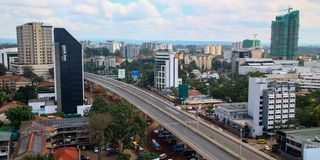
Today, it is Nairobi’s most restless hybrid, a district where glass towers rise in defiance of the old plan and traffic snarls choke the streets.
Johnson Denge, a real estate expert, says the changes unfolding in Westlands are not necessarily a sign of decline but rather a reconfiguration of the area’s function within Nairobi’s broader urban economy.
“There’s a lot of shift in demand in Westlands, and it’s attracting a new group of users. Westlands is increasingly becoming a mixed-use area, with commercial, residential, and hospitality developments coming up. The main factor driving this growth is road connectivity, especially with the expressway, which has greatly improved access to key amenities such as the airport,” he says.
Mr Denge argues that market fundamentals remain relatively resilient, even under pressure from the growing population density.
“Westlands is one of the few commercial markets where office rentals have increased year-on-year. Occupancy rates have been rising, mainly due to ability to attract multinationals. In terms of residential properties, given its proximity to the Blue Zone and its ability to attract expatriates, rentals have also increased,” he notes, adding that Westlands is one of the few markets that still commands a dollar rent charge.
“Despite a drop in residential property prices in 2025 of between 7 and 11 percent, driven by oversupply and price correction, there has been price stability in Q4 2025,” notes Mr Denge.
Residential sales prices range from Sh150,000 per square metre (PSQM) to Sh280,000 PSQM, depending on amenities, while rentals range from Sh1,300 PSQM to Sh3,000 PSQM per month.
He adds that Westlands’ tag of “city within a city” also defined the shift.
“It is self-contained or self-sufficient in that it can provide for the necessities, enabling it to operate as a commercial, residential or hospitality area.”
Johnson Denge a real estate expert.
Photo credit: Francis Nderitu | Nation Media Group
Additionally, he points out that the area continues to attract a younger, more mobile middle class who prioritise proximity to work, entertainment and services over expansive residential space.
“The area is increasingly changing into a mixed-use development. In such a development, there’s a symbiotic relationship between users, where people are always looking for a balance between work, play and living environments. This is prompting landlords to respond and over time, most areas have been converted for hospitality, entertainment and commercial purposes.”
Westlands' strength
This shift has also raised questions among investors about whether Westlands is still primarily residential or is gradually becoming more commercial.
“The strength is not in commercial use, but in mixed use, so it’s changing from being a strong residential area to a mixed-use area where several uses are coming together.”
This demographic shift is also reflected in unit preferences, with absorption concentrated in smaller housing typologies. “The highest absorption is in studio and one-bedroom units, with a slowdown in three- and four-bedroom units, as it largely attracts younger people who do not necessarily need more space or have larger families.”
Sustainability concerns
Mr Denge however cautions that without intervention, infrastructure strain could undermine long-term liveability.
“It is not sustainable unless something is done. There have been indications that the local physical and land use development plan is related to the attempt to manage the rapid densification and the associated infrastructure challenges.”
There is already strain on water, sewer and transport systems, and there are many traffic management issues. Privacy, access to sunlight and natural lighting are increasingly compromised. Green spaces are dwindling, and noise pollution and security concerns are rising.
These concerns are echoed by the Institution of Surveyors of Kenya, who argue that Westlands has already exceeded its original planning capacity.
High-rise buildings that dominate the skyline of Westlands Area on December 9, 2025.
Photo credit: Francis Nderitu | Nation Media Group
“The roads and sewer system were not designed to handle this kind of traffic or population.”
Eric Nyadimo, President of the Institution of Surveyors of Kenya, adds that while land values have increased due to demand for high-rise developments, there is an emerging risk of saturation.
“It will reach a saturation point when people will move to a less congested area. The value is likely to remain high.”
He warns that infrastructure limitations are now a central constraint on long-term sustainability, with existing systems unable to support intensified development patterns.
“The current infrastructure is unable to support the increased concretisation of the area. Zoning will also need to change; many residents are complaining about these developments.”
New regulatory framework
Recently, the county government sought to establish a new regulatory framework to guide future construction in Westlands and restore the balance between growth and liveability.
The Nairobi City County government is seeking to replan the area to limit new developments.
According to City Hall, developments in the area have spiralled out of control. “Originally envisioned as an upscale, low- to medium-rise residential district with controlled commercial activity, Westlands has undergone a rapid transformation characterised by high-rise apartments, commercial towers, mixed-use complexes and institutional developments,” City Hall said in a statement.
Over the years, Westlands and Upper Hill have primarily been targeted by developers for new projects, mainly comprising Grade A office units, to complement the Nairobi Central Business District, where such units were limited in supply and accessibility.
“This growth has intensified pressure on infrastructure systems such as water supply, sewage, storm water drainage, transport networks and social amenities including schools, healthcare facilities, recreational spaces and public utilities,” City Hall said.
“Additionally, emerging development patterns have raised concerns regarding environmental protection, land use compatibility, urban form, and the preservation of the unique character of neighbourhoods such as Loresho/Kyuna, Upper Spring Valley, and Parklands,” it added.
Institution of Surveyors of Kenya President Surv. Eric Nyadimo.
Photo credit: File | Nation Media Group
Westlands comprises seven upmarket estates, including Spring Valley, Parklands, Loresho, Kyuna, Kianda Triangle, Muthangari and Rhapta, all originally designed to be residential areas.
According to City Hall, while most of the new developments have followed the original plan, concerns have been raised about preserving the “unique character” of the neighbourhoods.
“The current development dynamics in Westlands highlight the urgent need for a comprehensive planning framework that balances urban growth, infrastructure capacity, environmental sustainability and metropolitan planning objectives,” they said.
It added that it has prioritised preparing the Local Physical Development Plan for the Westlands Zone, which is aligned with the Nairobi Integrated Urban Development Master Plan (2014–2030) and other national planning frameworks.
Currently, there are no proper guidelines for issuing permits for new developments. The repeal of the Physical Planning Act rendered the 2004 zoning guidelines, which were previously relied upon to issue permits, redundant.