Price of stand-alone two-bedroom house in leafy suburbs falls

Photo credit: Compiled by John Waweru | Designed by Stanslaus Manthi

The cost of two-bedroom stand-alone house in the leafy suburbs of Lavington, Runda and Karen has fallen since 2022, keeping the price at near par with those in middle income estate like Langata and Parklands, a new survey shows.

New data from the Kenya National Bureau of Statistics shows the smaller units in the high-end estates dropped to Sh8 million from Sh22 million in 2022 amid reduced demand.
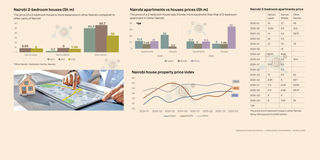
This kept the prices new a stand-alone two-bedroom cost of Sh7.78 million in middle income estate like Langata and Parklands.

Top earners and wealthy businessmen buying properties in the two zones appear to prefer larger units, whose costs have increased in double digits in the period under review.

A three-bedroom house in the high-end estate rose to Sh23 million from Sh20 million over the three years while four-bedroom home was up to Sh60 million from Sh40 million , a 50 percent jump.

The narrowing price gap between upper-income and middle-income estates points to growing pressure in Nairobi’s premium housing market, where developers and homeowners are struggling with slower sales, reduced speculative demand and tighter household budgets.

At Sh22 million in 2022, a two-bedroom house in Nairobi Upper cost more than six times the price of a similar unit in middle-income estates.

By 2025, the premium had almost disappeared, with upper-market houses costing only slightly more than homes in Nairobi Middle locations.

The decline reflects changing market dynamics in Kenya’s real estate sector, where high borrowing costs, expensive mortgages and weaker disposable incomes have pushed many buyers away from luxury property purchases.

Property analysts say middle-income estates are increasingly attracting demand from salaried professionals and first-time homeowners seeking relatively affordable homes with access to urban infrastructure.

The data also suggests that high-end property owners may have been forced to cut asking prices aggressively to attract buyers in a market experiencing slower transaction volumes.

Kenya’s housing market has in recent years faced mounting pressure from elevated construction costs, reduced access to credit and a broader economic slowdown that has weakened purchasing power.

While upper-income suburbs traditionally commanded strong price growth due to exclusivity and land scarcity, the latest figures indicate that affordability concerns are reshaping demand patterns across Nairobi’s residential market.

Follow our WhatsApp channel for the latest business and markets updates.

PAYE Tax Calculator

Note: The results are not exact but very close to the actual.