Kiambu County could have the tallest building outside Nairobi after Tatu City proposed two high-rise towers, the taller rising to 30 floors, in Ruiru, opening up a race to the skies beyond the capital.
The mixed-use high-rise development will be built on 9,518 square metres of land at Tatu Central’s CBD in Ruiru, Kiambu County, at an estimated cost of Sh7.09 billion, according to regulatory disclosures.
Dubbed Jabali Towers, the taller tower will rise to a height of 136.8 metres with 30 floors, while the shorter one will be 99.1 metres high with 20 floors.
“The proposed Jabali Towers will feature two high-rise residential towers, one with 20 floors and the other with 30 floors,” said the disclosures dated February 2026.
“The project site is located within Tatu City, approximately at Latitude 1.0901 and Longitude 36.5419 at Tatu Central, within the Central Business District (CBD) of Tatu City in Ruiru, Kiambu County,” the report adds.
If completed, this will be the tallest building outside Nairobi City. The country's tallest building by height is Britam Tower, located in Upper Hill, Nairobi, with 31 floors. Chinese-owned GTC Office Tower is the second tallest, at 184 metres, but has the highest floor count at 43.
Other skyscrapers in Nairobi include UAP Old Mutual Tower, which rises 163 metres across 33 floors; 88 Nairobi, standing at 150 metres with 47 floors; GTC Hotel Tower, which is 143 metres high with 35 floors; Times Tower, at 140 metres and 38 floors; and Prism Tower, which rises 133 metres across 34 floors.
The race to the skies in Nairobi has been driven partly by the scarcity and rising cost of land in the capital, pushing developers to build upwards to maximise the value of prime urban plots.
Kiambu County, part of the Nairobi Metropolitan Area, has benefited from the spillover of investment from the capital, as farmland is increasingly converted into real estate.
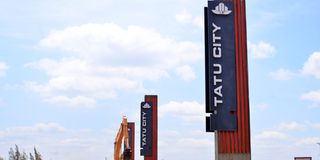
Tatu City sits on more than 5,000 acres of land that was formerly occupied by coffee farms off Thika Road.
The acquisition of the land to turn it into Tatu City, a master-planned mixed-use development, was inspired by the Kibaki administration's Vision 2030 infrastructure drive and the construction of the Thika Superhighway.
But as investors have flocked into the city, the developers are increasingly looking upwards, with the Jabali Towers project reflecting Tatu City's push for compact, high-density development.
“The project is consistent with Tatu City’s masterplan, which emphasises sustainable land use and compact development,” said Tatu City.
Jabali Towers will be largely residential, with studios and one-, two- and three-bedroom apartments, alongside amenities including a fitness centre, infinity pool, landscaped gardens, wellness facilities, co-working spaces and public plazas, as well as shops and restaurants.
The project comes as Tatu City has attracted more than 100 businesses and over 7,000 residents, with development in the 5,000-acre mixed-use Special Economic Zone now valued at more than $3.5 billion.
The race to the skies stalled at some point after plans for The Pinnacle in Upper Hill stalled.
The Sh20 billion mixed-use project was designed around a 67-storey, 320-metre tower that would have been Africa’s tallest building, alongside a second 45-storey tower housing a Hilton hotel, residential units and other commercial space.
But the race upwards is also facing resistance in parts of Nairobi, where residents in areas such as Kileleshwa, Kilimani, Lavington and Westlands have challenged high-rise developments over zoning, congestion and pressure on neighbourhood infrastructure—a debate that could increasingly follow the rapid vertical growth of Kiambu.