Time flies with great content! Renew in to keep enjoying all our premium content.
Prime
Innovation turning bare land into real estate gold
Elmun Nature Escapes in Kajiado, with three core designs, the dome inspired by the traditional manyatta, the 10 metre tall A frame with three bedrooms and a loft, and the modular Rhinopod.
Tucked away in Kajiado, just one and a half hours from Nairobi, sits a 15-acre property called Elmun Nature Escapes. It is a far cry from the arid land it was two years ago, when an acre was going for about Sh300,000.
When Andrew Muriungi bought it, he didn’t have a plan for it. He thought maybe his children would figure out what to do with it in 20 years. But, as is often the case, life had other ideas.
“I chose Kajiado because of the quiet, bushy surroundings and the open space. It’s only about an hour and a half from Nairobi, so it’s easy to travel there,” he says.
Mr Muriungi is a contractor and businessman who builds homes for people. “My company, Rhino Mabati, creates pre-engineered homes, meaning the parts are made in a factory and then assembled on site.”
He started building Rhinopods (assembled houses) at Elmun soon after buying the land, and the whole project took about one-and-a-half years to complete.
The red soil, acacia trees, seasonal rivers and natural white quartz rock scattered across the ground all provided the building materials.
About 90 percent of everything at Elmun came from his local factories. “The roofing is custom-made at Rhino Mabati and cut to the exact length of each building.
A 10-metre building gets a 10-metre sheet. The walls are built using light-gauge steel (LGS). It sounds technical, but the idea is simple. It is thinner than regular steel, yet it carries more weight. Every piece is machine-cut at the factory to precise measurements. When the team arrives on site, they assemble it.
Thermal insulation sits between the LGS walls, keeping the heat out and the cool air in. Dry walls made from channels and studs provide a neat finish on the inside.
The decking around all the outdoor areas is made of the same composite material used for swimming pools. It is designed to withstand water, heat and years of heavy use. The polyurethane (PU) panels on the solar pod resemble stone blocks from a distance. You would need to walk up and touch them to realise they are not real stone.
The white quartz rock found on the property has been shaped to create pathways and garden features. There is no artificial grass, as Mr Muriungi wanted to leave the ecosystem exactly as it is.
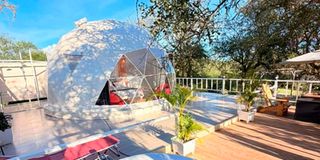
Elmun has three types of structures (pods), with prices ranging between Sh500,000 and Sh2 million, depending on the design. It is the traditional African manyatta-inspired dome-shaped pod that stops people in their tracks.
“With our domes, we are simply trying to recreate the manyatta in a futuristic way. What we are introducing here is already part of the landscape; now, it is finding its way back with a futuristic twist.”
Inside, there is a one-bedroom space fitted with a queen-size bed, a coffee table, and an ensuite bathroom. The round shape allows air to circulate naturally, so there is no need for air conditioning, even in the intense Kajiado sunshine.
The A-frame is the most ambitious structure on the property. Standing 10 metres tall, it has three floors, three bedrooms and a loft at the top. The outer layer is a matte-finish roofing sheet called the Jamini profile that is made in one piece and runs the full 10-metre height.
There are no joins or patches. The windows are carefully positioned to allow wind to enter from one side and exit from the other, ensuring continuous airflow without the need for a fan. The A-frame also has a hot tub, an outdoor deck and a fire pit. Guests can sit outside and watch the cattle grazing nearby. The entire structure was completed in just 45 days.
The modular pod is the most flexible option. It is ideal for those who want to experiment with the concept on their own land. It is rectangular, manufactured in a factory and quick to assemble on site. It can be made bigger or smaller, and can be used for personal living or short-term rental. Prices start at Sh50,000, and construction can be staged as funds become available.
The most challenging aspect of the construction process was not the structure itself, but the plumbing system. As Mr Muriungi explains, “The pipes run underground and are heated by the sun during the day. By the time the hot water reaches the last house, it has cooled down again. This made it difficult to manage the temperature of the water across all units.”
Andrew Muriungi, is the founder and Managing Director of Rhino Mabati. He owns Elmun Nature Escapes, a 15-acre farm with a working model of pre engineered housing, sustainable living, and income generating real estate.
Photo credit: Pool
Each unit has a footprint of about 10 by six metres, and the decking and outdoor space extend the living area to about 12 by 15 metres. Nothing is dug into the ground except the piers that support the buildings.
“We suspend the floors so that we do not disturb the environment at all,” says Mr Muriungi. “The surrounding area is just a normal jungle.” The entire property runs on a 60 kVA solar system, providing about 50 kilowatts of power. This is enough to power a small factory. It powers water pumps, lighting, fridges, the hot tub and all appliances across the site.
“We are completely off the grid when it comes to Kenya Power,” says Mr Muriungi.
“We have excess energy. We can run the laundry, fridges and freezers. It is a complete, self-sufficient ecosystem.”
The space under the solar panels has been converted into a shaded living area, which stays cool due to the airflow between the panels and the roof.
Last December, the property drilled a borehole after many neighbouring farms had tried and failed to find water. They succeeded, however, and now share the water with the surrounding community.
This is where the real estate conversation becomes very interesting.
Mr Muriungi did not build Elmun purely for his own enjoyment.
He created it as a working model to demonstrate to landowners across Kenya what can be achieved.
“I call it the ATM of real estate,” he says. “A single one-bedroom pod earns between Sh30,000 and 50,000 per night. With a minimum of two bookings per weekend across four weekends, that equates to at least Sh160,000 per month from one unit alone. If occupancy rises to 50 percent, the numbers increase significantly.”
The building process is just as important as the cost. First, an architect meets the client to understand their needs. They discuss family size, lifestyle, how the space will be used and whether it is intended for personal use or short-term rental.
“The budget you work with is precise. If there is an adjustment, it is usually due to the terrain or something that has changed on site. But what we agree on is what we deliver.”
Elmun Nature Escapes in Kajiado, with three core designs, the dome inspired by the traditional manyatta, the 10 metre tall A frame with three bedrooms and a loft, and the modular Rhinopod.
Photo credit: Pool
The farm side of Elmun is not just for show. Livestock manure fertilises the land, eggs from the chickens reduce food costs and the goats keep the grass short, eliminating the need for clearing and related costs.
Black soldier flies will soon be introduced to produce extra protein for the animals, reducing feed costs even further. The goal is simple. Nothing should be brought in from outside if it can be produced on the land.
There are challenges, and Andrew is open about them. The biggest challenge is neither the weather nor the market. It is how easy the idea is to copy.
“It's easy for others to replicate this. If you are not innovative, you might find similar units popping up everywhere. You have to be on your toes.”
Finding land with the right features is not easy. It needs to have a good view and accessible roads, and it must be close enough to a town. Not every plot of land is suitable, and Andrew makes this clear to every investor. Currently, Andrew has on-going projects in Nanyuki, Kilifi and Saikeri in Ngong.
“When you have the courage to do the right thing, you'll be amazed at how things can change.”