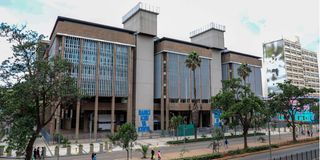
The Central Bank of Kenya (CBK) is seeking Sh150 billion from three reopened infrastructure bonds that will make it easier to repay heavy Treasury bills that are maturing from mid this month amid a cash crunch.
The State is facing pressure to repay Sh195.7 billion in 91-day Treasury bills over the next three months after a heavy uptake of debt on the short term security since mid-May.
Infrastructure bonds tend to be popular with investors due to their tax-free status, making them a useful tool for the Treasury when it is looking to raise large sums from the domestic market.
The large target will also help the CBK in its search for billions in new debt as it races to fill the government’s domestic borrowing target of Sh987.4 billion for the 2026/2027 financial year.
Heavy foreign and domestic interest payments strained public coffers, forcing delayed disbursements to local authorities and payments to contractors.
To address the heavy 91-day T-bill maturities, the CBK has also opened a switch bond, a government paper that allows investors to swap an existing security for another.
It involves the direct conversion of maturing Treasury bills and bonds into longer-term securities, cushioning the Treasury from heavy debt repayments.
Now, the Treasury is targeting Sh15 billion of the T-bills due to be repaid on September 7 and a 15-year bond from September 2012 that also matures on the same day with the switch bond.The 15-year bond pays investors 11 percent in annual interest.
Investors holding these papers are being asked to directly roll over their funds into a 10-year bond that was sold in November 2019 at an annual interest rate of 12.28 percent, and which has 3.2 years to maturity.
The twin-pronged effort to raise a large cash amount via an infrastructure bond and transfer maturities into longer paper through the switch offer shows that the Treasury is wary of a cash crunch when the T-bill maturities fall due.
The T-bills auctions have been skewed towards the 91-day paper since mid-May, as investors avoid locking in their money for long periods as interest rates go up.
Financial markets have been volatile since February, marked by shocks from the Iran war that has caused higher global inflation.
The 91-day paper has netted Sh195.7 billion over the last two months, well ahead of the 182-day paper’s Sh67.2 billion and Sh62.6 billion for the 364-day paper.
In the previous 10 weeks between March and mid-May, the 91-day paper had raised Sh67 billion, while the other two tenors had raised Sh74 billion each.
The Treasury faced such a crisis in March 2017, when investors were pumping in large volumes of cash into the 182-day T-bill.
It responded by suspending the issuance of the six-month paper for two months to prevent refinancing problems down the road. This had the effect of pushing bids to the other two tenors, spreading future repayments.
The CBK therefore prefers an even spread in volumes between the three tenors in order to maintain a steady maturity profile of the short-term debt throughout the fiscal year.
In the government securities market, investors can either take out their money or roll it over into new securities when the debt comes due. When the maturities are large, investors usually demand a higher interest rate in order to do a rollover.
By turning to infrastructure bonds, the government is now hoping to solve the potential refinancing hiccup without a risk of higher interest rates.
The three reopened bonds have also been issued at relatively friendly rates that fall in line with recent bond auctions.
The August sale comprises a reopened 16-year infrastructure bond that was first issued in 2019 at an annual rate of 11.75 percent, an 18-year paper from 2021 that pays 12.66 percent and a 21-year bond that was also issued in 2021 an annual rate of 12.73 percent.
The three tax-free bonds have periods to maturity of between 9.3 and 16.2 years.
Recent bond sales have seen the CBK reopen long-term papers of between 15 and 25 years, with interest rates of between 12 and 14.2 percent. Such bonds therefore earn investors between 10.9 percent and 12.8 percent, after levying the 10 percent withholding tax on interest.