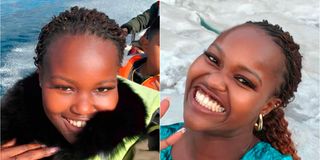
In July, Netty Nyong’a decided to travel alone to Mongolia for a month. She had always been fascinated by the country’s rich traditions and nomadic way of life. “Most of the people there are nomadic. They move with the seasons, four times a year,” she tells BDLife.
A tax consultant by profession, she says her job is high-pressure and demanding, the kind of work that follows people home through emails and late-night calls. She wanted a break and a different feel to nomadic life.
“Most of us have accumulated so many things and hold on to them so tightly that, if we were asked to leave today, they would hold us back,” she says.
She had travelled to Bali, Cape Town, Mauritius, the United Arab Emirates, Tanzania and Uganda, but she says these were holidays.
“Mongolia was for adventure. Not for the flashy selfies or picture-perfect moments shared on Instagram,” says the 26-year-old.
Year-long planning
She took a year to plan the trip. She had hoped to travel in December, but a local guide advised her against it because of the extreme cold.
“December is deep winter in Mongolia, when temperatures can drop to as low as minus 65 degrees Celsius,” she says.
So she chose July, when the country experiences a short summer.
With everything in place, all she needed was to attune her body to the adventurous trip.
“I started working on losing weight,” she says, knowing the adventure would demand more of her than any holiday she had taken before. The trip involved long walks, hiking, camel riding and swimming.
Then came the packing. Just how many clothes do you need for a month-long holiday that takes you through two extremes: a scorching desert one day and a snow-capped mountain the next?
“In Mongolia, there are places you’ll visit covered in ice and snow, yet it is summer. I was also not a seasoned hiker. At the end I realised I didn’t even need half of this stuff,” she says.
Netty Nyakiambori Nyong’a, 26, is a Kenyan tax consultant who spent one month on a self-sponsored adventure across Mongolia. She lived with nomadic communities, rode horses, encountered reindeer, camped, and milked goats in the Gobi Desert, trading routine for an unforgettable journey of culture, resilience, and discovery.
Photo credit: Pool
Getting her tourist visa took about five days. The process involved detailed questions about her social media accounts and whether she had any skills involving weapons.
“They wanted to understand my real purpose of going there and who I am. But it did not feel too invasive,” she says.
She flew through Thailand and Beijing before arriving in Mongolia, paying about Sh120,000 for her Air China ticket.
“I do have a sizable discount with Kenya Airways (KQ). But full price would have been a bit pricey,” she says, adding that a KQ ticket would have cost her about Sh200,000.
Language barrier
The journey took two full days. From above, the land looked endless and empty, broken only by traditional Mongolian homes called gers, scattered. “It is just such a huge space with nothing,” she says.
As she drove into the capital, Ulaanbaatar, she saw the country’s layered history side by side — old Soviet-era buildings alongside modern skyscrapers, with traditional gers appearing in the middle of neighbourhoods.
“That was one of the things that really struck me,” she says.
Mongolia uses the Cyrillic alphabet, which she could not read. “I couldn’t even read a billboard,” she says.
She relied on a driver arranged through a logistics contact she had found in a TikTok comment to communicate. For the first two and a half weeks, they communicated mostly through sign language and patience, especially in places without internet access for translation apps.
She found her first accommodation, a hostel, which she paid Sh6,000 for three nights.
The adventure started with the Naadam Festival. “Often described as Mongolia’s version of the Olympics, it is held during the country’s short 10-day summer break. It is a huge festival,” she says.
She spent two days there before moving into the rest of her itinerary. She wanted to see reindeer, live with nomads, milk goats and ride camels.
Food was one of the biggest adjustments she had to make. Most meals had cow, goat, sheep or yak meat and dough, since Mongolian families keep large herds.”
Chicken was almost impossible to find. “I was told, in a vast land like Mongolia, there are too many natural predators for chicken: eagles, hawks, bears, wolves and foxes. Chickens would not survive there,” she says.
A ride on horses
She travelled to one of the most remote parts of Mongolia, where she visited the Tsaatan people, reindeer herders who live near the Russian border. It took four days of driving just to get near them, and eventually the car could go no further.
“We had to ditch the car and take horses,” she says.
Getting up into their world came with its own cost. Altitude sickness set in during the horse ride into the mountains, and she was given shots of vodka as an unlikely remedy.
“We were so high up in the mountains that I became dizzy. Usually, locals deal with that by taking a few shots of vodka,” she says.
In Mongolia, horse riding is not just a pastime but a means of transport. “At a red light stop in traffic, with cars waiting, I’d see people on their horses. This is a way of life,” she says.
Integrating with the Tsaatan, she learned about shamanism, the country's dominant belief system, centred on living in harmony with nature and ancestors. “It is that if I live well with nature and I live in harmony, then surely nature will also give to me,” she says.
Netty Nyakiambori Nyong’a, 26, is a Kenyan tax consultant who spent one month on a self-sponsored adventure across Mongolia. She lived with nomadic communities, rode horses, encountered reindeer, camped, and milked goats in the Gobi Desert, trading routine for an unforgettable journey of culture, resilience, and discovery.
Photo credit: Pool
She had hoped to meet a shaman during her stay, but he had gone further into the mountains to heal himself first.
Dogs scare
Life among the reindeer herders is basic. They live in tents made of sticks and tarpaulin, offering little protection from the weather or animals. “The top is left open, so if it rains, you are rained on,” she says.
One night, a pack of dogs entered the camp and stole their food while they slept.
“I remember waking up scared, just hearing them tearing through our things. There was nothing really between them and us,” she says.
From that unsettled night in the mountains, her journey took her south, to the Gobi Desert, where she went to milk goats and stayed with a nomadic family who spoke no English at all. “Not hello, not yes and no, nothing. It was fully body language experience,” she says.
Her tent stood alone at the bottom of a mountain, surrounded by stinging plants she only noticed once it was dark. The family relied on an unstable Starlink connection for the rare moment of internet access, and even Google Translate struggled with the language.
“It does not do the majority of the communication. It kind of just gives your ideas, and then you try and fill it in again,” she says.
Cut off from any real conversation, she sensed the family felt uneasy around her, though she was never able to figure out why. “I was not sure whether they were uncomfortable with my presence. I spent a lot of time on edge,” she says.
After two nights instead of the planned week, that unease pushed her to leave early. “I had to run away,” she tells BDLife, laughing at that memory.
“Everything hurt”
Escaping the desert meant getting back on a horse, the same horse ride that had carried her to the reindeer tribe earlier in the trip. It was supposed to take six and a half hours. It took nine and a half. She fell off at one point.
“Everything hurt because you are jumping up and down on this horse. You have no back support,” she says. “I was second-guessing myself a lot. I was telling myself, okay, now I’ve deluded a bit too far,” she says.
That same delusion, as she calls it, carried her through the most frightening moment of the whole trip, deep in the desert. An old nomadic man was driving her to his family’s home, fast over rocky, unmarked terrain as night fell, when their tyre burst with no spare, no network and no light for miles. “No one knew what to do. He opened the car boot. Shock, there was no spare tyre,” she says.
With nothing else to do, they climbed sand dunes to catch a single bar of signal and call for help. It took nearly two hours before someone arrived with a tyre, and Netty fitted it herself. “It looked like he was not too comfortable changing the tyre. So I changed the tyre.”
She says she wasn’t really fearful. “My life motto is kukufa ni once [I die once]. No matter how bad the situation gets, it can only kill you once. There is no time for anxiety and regret. You might as well live,” she says.
Being an object of spectacle
She noticed something unexpected: how people responded to her height and build. Strangers would stop her just to take pictures.
“Mongolians know Kenyans for running only. They don’t even know where it is, but they know we are runners,” she says.
Netty Nyakiambori Nyong’a, 26, is a Kenyan tax consultant who spent one month on a self-sponsored adventure across Mongolia. She lived with nomadic communities, rode horses, encountered reindeer, camped, and milked goats in the Gobi Desert, trading routine for an unforgettable journey of culture, resilience, and discovery.
Photo credit: Pool
Netty says if you are looking to travel to Mongolia, start with fewer days, perhaps two weeks instead of a month. Also, itemise the expenses instead of lumping everything into one figure. “There are some expenses that you will know outright when you are still at home. Get those sorted out a long time before,” she says.
She also recalls her early hostel nights in Ulaanbaatar as proof of how far a small budget can stretch. Hostels were much cheaper than hotels and often brought together travellers who would team up and share transport costs. “You would wake up, and somebody has written a note on the table: Is there anyone willing to join me so we can share? '” she says.
Visa requirements
She warns travellers to check visa requirements because of connecting through multiple countries, since checked luggage sometimes needs its own valid visa path. She nearly got stranded on her return journey because of a mismatch between her flights.
She came home with fridge magnets and traditional Mongolian clothing as souvenirs.
“It is a big thing to have great traditional attire. Some of them even go up to Sh51,000 to Sh64,000 for one piece,” she says, adding, “this was an experience that was so worthwhile, an adventure of a lifetime. Even if it meant spending my entire life savings, I was going to do it. And I don’t regret it,” she says.
How much did she spend?
“About Sh850,000,” she says, adding that she does not want the life others expect of her: a regular job, marriage, children and settling down.
“I don’t believe the traditional path of life is for me. I believe my purpose in life is to explore the world,” she says.
When asked where she will travel next, she laughs at her own ambition.
“I’m very delusional, very ambitious, especially now that I absolutely have no money. I want to go to the North Pole. That's what's next.”