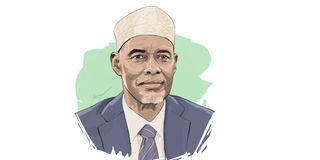
Before last week’s nomination to the Supreme Court, Justice Mohamed Warsame had built a reputation for a consistent approach to commercial law, marked by firm enforcement of contracts and protection of property rights.
During the interviews, much of the national attention focused on his colleague at the Court of Appeal, Katwa Kigen, over his past legal work for President William Ruto and whether it could undermine public confidence in his impartiality.
Little national debate surrounded Mr Warsame’s potential rise until Judicial Service Commission (JSC) chairperson Chief Justice Martha Koome announced it a few hours after the interviews closed.
A review of Mr Warsame’s rulings shows strict application of contractual obligations alongside close scrutiny of administrative decisions for legality and an insistence on clarity in business transactions.
His elevation from the Court of Appeal to the Supreme Court crowns a career defined by firm rulings at both the Court of Appeal and High Court, administrative reforms and constitutional litigation that reshaped judicial governance.
Mr Warsame’s nomination by the JSC emerged from a tightly contested process that tested jurisprudence, integrity and administrative record. His answers and past rulings placed him at the centre of Kenya’s evolving commercial and constitutional law.
He told the commission he brings “over 32 years of legal experience” grounded in advocacy and judicial service. He framed the Supreme Court as a court of direction and principle. “It is the Supreme Court that leads the country in the right direction,” he said during the interview.
His legal philosophy was forged early in his career in private practice, where he trained at Anjarwalla Abdulhussein & Co. Advocates in 1994, the same year he was admitted to the Roll of Advocates.
He graduated from the University of Nairobi in 1992 before enrolling for a Postgraduate Diploma in Law at the Kenya School of Law, which he completed in 1993.
He moved to Wahome & Co. Advocates in 1995, worked as a lead litigation associate and later founded Warsame & Co. Advocates in 1996.
He joined the bench as an acting puisne judge in 2003 before appointment to the High Court in 2004.
Commercial record
It is at the High Court, particularly in the commercial and judicial review divisions, that Justice Warsame established his signature style. His rulings emphasised strict compliance with contractual obligations, efficient dispute resolution and protection of proprietary rights.
In one case pitting Jaribu Holdings Ltd against Kenya Commercial Bank, he ordered a tenant to vacate leased residential premises and settle rent arrears after finding a clear breach of contractual terms.
The bank had alleged breach of contract regarding unauthorised subletting and over Sh2.2 million in unpaid rent for the property situated along Argwings Kodhek Road in Hurlingham, Nairobi.
“It is not available to the tenant to change the user of the suit premises without the consent of the owner and then allege that it is a controlled tenant,” the judge ruled.
The decision, delivered in November 2007, enforced the lease without modification and underscored that courts must uphold commercial agreements as written.
The ruling has since been cited at the Court of Appeal, particularly on the principles governing stay of execution and enforcement of commercial obligations.
That approach aligns with the long-established doctrine that courts cannot rewrite contracts between parties.
Justice Warsame consistently applied that principle in commercial disputes, reinforcing certainty in business dealings and limiting judicial interference in negotiated agreements.
Legal limits
His jurisprudence extended beyond enforcement to oversight. In another commercial dispute pitting Baseline Architects Limited against the National Hospital Insurance Fund Board of Management, he disallowed the use of illegally obtained documents by a contractor to demand payment for a Sh352 million arbitral award, saying this offended public policy.
He held that reliance on improperly obtained confidential documents from the State undermined the integrity of the arbitral process and could not stand.
“A party cannot be allowed to use a benefit which he obtained in contravention of the law,” he stated.
That decision, delivered in May 2008, drew a distinction between contractual freedom and legality, affirming that arbitration outcomes must comply with constitutional and procedural standards.
The ruling has also been cited in the determination of other commercial cases.
It reinforced the court’s supervisory role over administrative bodies and dispute resolution mechanisms.
The dispute concerned consultancy works for the design and supervision to completion of a proposed training and resource centre for NHIF in Karen, Nairobi.
Judicial reform
Justice Warsame’s work in judicial review further expanded administrative accountability under the 2010 Constitution.
As the first presiding judge of the Judicial Review Division, he helped shift the remedy from a narrow common law tool to a constitutional safeguard anchored in fair administrative action.
“I have dealt with all spheres of the law,” he told the JSC panel during last week’s interviews. “I was the first presiding judge of the Judicial Review Division under the current Constitution.”
His tenure coincided with growing scrutiny over delays in the Judiciary, with colleagues crediting him for firm case management and reducing backlog.
He later chaired the Judiciary’s Community Service and Probation Committee, overseeing the release of more than 7,000 petty offenders through non-custodial measures, helping decongest correctional facilities.
Institutional battles
Justice Warsame’s elevation to the Court of Appeal in 2012 broadened his influence, where he handled complex constitutional and commercial disputes while maintaining emphasis on legal certainty and procedural discipline.
Beyond adjudication, he served for a decade at the JSC between 2013 and 2023, representing Court of Appeal judges. His tenure placed him at the centre of a constitutional dispute over the independence of the commission.
After his peers re-elected him in 2018, then President Uhuru Kenyatta declined to gazette him and sought parliamentary vetting and approval.
The move triggered litigation by the Law Society of Kenya (LSK) and Mr Warsame.
The High Court barred the National Assembly from vetting him, and the dispute reached the Supreme Court, which affirmed that elected JSC members are not subject to parliamentary approval.
The ruling clarified the constitutional framework governing appointments and reinforced institutional independence.
Public profile
During his Supreme Court interview, commissioners said public submissions about him were largely positive, describing him as straightforward and approachable.
Professional bodies, including LSK branches in North Rift and Nakuru, credited him with improving access to justice and addressing case backlog.
“I would describe myself as a person with a golden heart. I can relate with anybody irrespective of status,” he said.
Senior Counsel Bar chairperson Phillip Murgor also welcomed his nomination, describing him as a “hardworking judge of high reputation” with “unquestionable integrity”.
Justice Warsame also used the interview to outline his judicial outlook, stressing that the Constitution must be interpreted through its text and history rather than public pressure.
“The Constitution is a social contract,” he said, adding that courts must give it consistent meaning.
As he awaits parliamentary approval to join the Supreme Court, his nomination comes at a critical time.
The vacancy arose after the death of Justice Mohamed Ibrahim in December 2025, leaving the court below its full seven-member bench.
The court remains central to resolving constitutional disputes and presidential election petitions.
His record reflects a judge who combines strict enforcement of commercial rights with a clear insistence on legality in administrative action.
His rulings in commercial disputes, arbitration and judicial review continue to shape Kenya’s legal landscape as he transitions to the apex court.