Steven Kanja brings grief, music and theatre to the stage

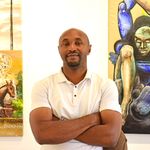
Mugambi Ikiara, who plays the heartbroken lover and singer for FRGMNTS II during rehearsal at PPMC, State House Road, Nairobi on August 7, 2026. FRGMNTS II is a showcase which sits somewhere between a live music showcase, theatre and performance art. The music remains its core, but the songs are woven into a larger narrative using spoken-word/narration, acting, stage movement, lighting, set design and visual symbolism.

Photo credit: Thomas Rajula | Nation Media Group

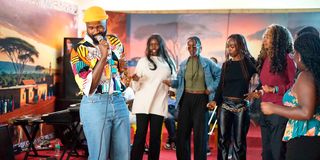
When performing musician, composer and keyboardist Steven Kanja attended Showman Residency by Nyashinski in April this year, he was struck by how similar the concert's concept resembled what he had put out in February through his FRGMNTS showcase.

Sure, his stage wasn't as grand as Nyashinski's. Neither did he have the over a 100 personnel in the form of acrobats, dancers, choir, fire breathers or skaters. But using narrators and actors to help tell the story behind the songs was something Kanja had conceptualised and brought to life earlier.
More than the coincidence, however, was the validation.

“I was so impressed by what went down,” Kanja recalls. “When I saw it, it was so much just like our show. It was validating.”

For Kanja, FRGMNTS was never intended to be simply another concert. It was an attempt to answer a question that had been bothering him: What if music alone is not enough to tell a story?

The answer, he decided, was to put other forms of art alongside it. And in staging FRGMNTS 2 at the Kenya National Theatre this Saturday, August 15, he is taking that experiment even further.

From brokenness to becoming whole

The idea behind FRGMNTS is contained in its name — becoming whole from a fragmented self.

The first edition was born out of one of the most difficult periods of Kanja's life. Last year, he lost his fiancée and later a childhood friend to suicide.

It left him “really broken internally”. The songs that eventually formed FRGMNTS emerged from that period of grief. “But from that broken, fragmented self, I felt like I grew as a person,” he says.

The result was not merely an album or a collection of songs. Kanja wanted to create a performance through which the audience could experience the emotions behind them.

That required him to look beyond music. “I always think the music cannot explain it all sometimes,” he says. “Same way talking cannot just explain sometimes, I think it needs to be together.”

For Kanja, a chord can make him feel something that another person might not necessarily feel. Words can explain something that music cannot. At other times, neither is sufficient.

“So for me, it's really about communicating some things in the best palette possible, in the best canvas,” he explains.

That palette could include poetry, spoken word, conversation, music, drama or acting. For FRGMNTS 2, it meant all of them.

When a concert became something else

The evolution from the first FRGMNTS to the second has been significant.

The first edition featured Kanja's band, three background vocalists (BGVs) and one narrator. The latest version has two narrators, the BGVs as a choir and stage and film actor/artiste Mugambi Ikiara, who contributes movement, art and humour to the performance.

The 15-song set is largely drawn from music Kanja created over roughly a year, with most of the compositions coming from the period following his losses.

But the music is only one layer of the performance. Kanja also designed the set, incorporating structures that allow him to play with shadows and light. The scripting was developed by Kanja and his two narrators, Husna Kipsoi and Koome Kinoti.

The people around him did not immediately understand what he was attempting. When he first told his band that he wanted to stage a show at the Kenya National Theatre in February, they assumed it would be another concert.

“I don't think anybody understood,” he says. “I think guys were just trusting me.”

Many of the musicians had previously played with him in restaurants. So, when he told them there would be narrators and a narrative running through the performance, they could not quite picture it.

It was only when they arrived at rehearsals and saw the set, lighting and movement come together that the idea began to make sense.

Even then, Kanja was asking himself how far he could stretch the boundaries of a conventional musical performance.

There is a reason the production feels different from a conventional concert: it demands more from Kanja.

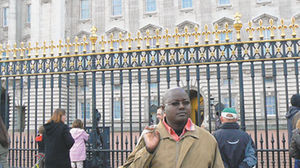
Steven Kanja (in cap) is the the musician behind the idea of FRGMNTS, a showcase which sits somewhere between a live music showcase, theatre and performance art. The music remains its core, but the songs are woven into a larger narrative using spoken-word/narration, acting, stage movement, lighting, set design and visual symbolism. He was rehearsing with Husna Kipsoi, a narrator and scriptwriter for FRGMNTS II at PPMC, State House Road, Nairobi on August 7, 2026. 

Photo credit: Thomas Rajula | Nation Media Group

For the first time, he has had to incorporate acting into his performance.

He has no formal acting background and readily admits that he does not consider himself particularly good at it.

“This one is definitely harder, but it's way more fulfilling because it's holistic,” he says.

The challenge is part of the appeal. Kanja has always been a musician who taught himself. His fascination with the piano began when he was about 10, but his parents did not initially see music as a viable pursuit. They encouraged him toward formal education instead.

His mother told him he could learn music in high school. His high school did not offer it. Then he was told university would give him the time to pursue it.

Eventually, Kanja decided he would teach himself.

His parents bought him a keyboard, and he began learning. He borrowed music examinations from friends who attended music schools and used them to measure his progress.

He started with classical music, later became a rapper and spent much of his university years making hip-hop. Then he stopped making music altogether for two or three years. He simply did not feel he had anything to tell the world.

That was until the losses came. “I had something to tell the world, but I couldn't drop it,” he says. FRGMNTS became his way of doing so.

A show about everyone

It would be easy to describe the performance as a story about grief or the struggles of the modern man. But Kanja is reluctant to prescribe a single interpretation.

Asked whether FRGMNTS 2 is about, the boy child's struggles or the wider human experience, he is unequivocal. “It's a human struggle. It's just that I'm a boy.”

The performance explores the things people use to avoid confronting themselves — drugs, alcohol, sex, money, comfort or any other habit that offers an easier escape than confronting one's struggles.

But Kanja does not want to stand on stage and tell his audience what they should think. That, he believes, is not what art should do.
“I shouldn't tell you what to do,” he says. “I shouldn't tell you this is how it is.”

Instead, he wants to place the questions in front of the audience and allow them to find their own answers. His approach comes from an understanding that people experience the same things differently.

Turning pain into a language

That philosophy may explain why Kanja was able to create FRGMNTS in the first place.

There was no neat moment when he decided he was finally ready to speak about his grief. He simply had to find a way to survive it.

When asked when he felt ready to tell such a personal story, his answer is strikingly blunt. “There's no option,” he says.

He recalls a line from a poem: a man either becomes a writer or jumps off a bridge.

For Kanja, creating was the alternative to remaining trapped in the place he had found himself.

“I was in a really bad place,” he says. “So this is how I'm expressing it. For me, it's really, yeah, it's either that or I die.”

That makes FRGMNTS more than an artistic experiment. It is the language Kanja found when ordinary language failed him.

A different kind of concert

There is, however, another challenge facing the performance: convincing audiences to pay for something they cannot easily categorise.
Kanja admits that FRGMNTS is difficult to sell precisely because it is not straightforward.

A poster promising Kanja and Mugambi performing their songs is easy enough to understand. A concert combining music, architecture, acting, narration, movement and other art forms is harder to package.

“Just because it's something new, it's a bit harder to sell in the beginning,” he says.

That is why he was particularly encouraged by seeing elements of his concept appear in Showman Residency.

He does not claim ownership of the idea, nor does he suggest Nyashinski's production was influenced by his work.

Instead, he saw something reassuring in the coincidence.

Perhaps audiences are becoming ready for concerts that offer more than music.

Perhaps the concert itself is evolving.

For Kanja, that evolution is exactly where he wants to be.

Beyond the song

A successful FRGMNTS show, however, has two measures.

The first is practical: it needs to sell enough tickets to make financial sense.

There is a band to pay, a choir, crew, equipment and a venue. The Kenya National Theatre costs Sh40,000 to hire, and Kanja understands that artistic ambition does not exempt a production from the realities of business.

But the second measure matters more to him.

He wants people to recognise themselves in what they see.

“The most important thing for me would be having people see our common humanity because we are more similar than we are different,” he says.

That, ultimately, is what Kanja is attempting with FRGMNTS 2: not to explain the human experience to an audience, but to hold up a mirror.
Music provides one language. Acting provides another. Narration fills in what the songs cannot. Architecture shapes the space. Shadows alter what the audience sees.

Together, they become the canvas he has been searching for.

And perhaps that is why watching a much bigger production attempt something similar did not make Kanja feel overshadowed.

It made him feel understood.

PAYE Tax Calculator

Note: The results are not exact but very close to the actual.