Since 2017, once every year, the Sheikh Zayed Road - Dubai’s main artery - turns pedestrian. For several hours, the highway becomes a vast, car-free playground.
I’m in Dubai for the annual 30x30 Fitness Challenge, a month-long citywide invitation to move, sweat, and breathe.
For this year's edition, I was among the 307,000 people, residents and tourists who flooded the Dubai streets to experience the surreal thrill of running last month.
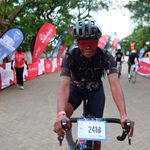
Earlier in the month, the same road was transformed into a giant cycling track for the Dubai Ride, attracting over 40,000 cyclists of all ages and skill levels. But I digress.
At exactly 6:45 a.m., the gun fires, the run begins. I've signed up for the 10KM—a test of patience, of heart, of lungs endurance exam. I glide through the futuristic skyline, past Dubai’s most iconic landmarks, the Museum of the Future, the towering Burj Khalifa, and the Dubai Water Canal.
Vincent and Maria Kivaa after finishing the 10KM Dubai Run to mark the end of Dubai 30 X 30 Fitness Challenge 2025.
Photo credit: Sinda Matiko I Nation Media Group
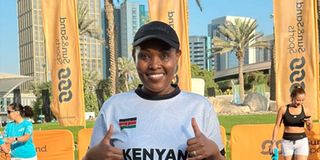
52 minutes later, I crossed the finish line. Twenty minutes later, still catching my breath and still gulping tiny 100ml water bottles like a dehydrated marathoner, I spot a Kenyan jersey cutting through the crowd. Maria Kivaa. Instantly, she has my attention.
"How was the run?" I manage between breaths.
"Wow, that was fun." she answers, realising her Kenyan accent mirrors mine.
Then her story spills out.
“I’ve been running for a while now. I started back home, and when I moved here to Dubai a year and a half ago, I stayed consistent. This time of year - winter- there’s a race almost every weekend, but the Dubai Run? It's different. Special. There’s a big Kenyan running community here in Dubai.”
Fitness routine
She gestures at the controlled chaos around us.
"It's special in the sense that it closes the city down. The municipality shuts down the main road- Sheikh Zayed Road. No cars, businesses paused, and everyone from residents
Maria Kivaa executing single arm supported dumbbell Row at the residential gym in Dubai, Arabian Ranches.
Photo credit: Photo I Pool
to tourists gets to take over the road.
"Ten or five kilometres you choose, no registration fee, bibs provided, water everywhere, bands playing along the route. It’s a cultural thing here. People come just for the experience of it, the joy of it. You saw how the crowd turned out.”
I nod, remembering the bands stationed at different stretches of the highway, each section pulsing with different rhythms.
Every few metres the music shifted, afrobeat thumping, Arabic drums rolling, pop anthems lifting the spirits of the tired legs and making the run under the beautiful early breeze feel lighter, and an enjoyable experience.
Even the elderly showed up for joy. A man who must have been pushing 70 blazed past me like a gust of wind. I never caught up, not even close.
Only spotted him later at the finish, seated on the green lawn, smiling like he had done this a thousand times. He was faster, stronger, and more agile than me. I’ll admit that defeat gracefully.
For Maria, though, this wasn’t merely a fun run. This was fuel, another layer in her already disciplined fitness routine.
The mother of two, aged 10 and 8, radiates the energy of someone in her mid-thirties, though she’s 42. Dubai made her intentional. She wasn’t always like this.
"This wasn't always me. A year and half ago, before Dubai, I was someone else. I ate everything. Didn't move much and was overweight. My body kept score."
The scar she carries isn't visible, but it runs deep, a dark road in the past that still shapes every step she takes today.
“12 years ago, I lost my first baby to pre-eclampsia. That experience changed everything. After losing my first child, I realised life is precious and I have to take care of my body. That's why I run now. I run for my body, for my mind, for my soul. I run because I would never want to have such an experience again. That loss was one of the darkest chapters of my life. I can't undo it. But I can make sure it never happens again. So, shedding excess weight reduces the chances of pre-eclampsia recurring," she explains.
Pre-eclampsia is a pregnancy complication marked by high blood pressure and signs of organ stress, often affecting the kidneys or liver, that usually develops after the 20th week.
It can escalate quickly if untreated, posing risks to both mother and baby.
Although she had laced up back in Kenya, she remained inconsistent bursts between life's other demands. But Dubai changed everything. Her younger brother Vincent, entrenched in the city's fitness industry for 15 years, became her architect of transformation.
"Vincent is the reason for my transformation. When I arrived here, he didn't just help me settle, he rebuilt me. Connected me with running groups. Drafted my diet plans. Designed my workout programs. He saw what I needed to become before I could see it myself."
Her progress is written not just in her stride and physique but in sharp numbers. She has shed 20kgs since her arrival, weighs 70 kgs now, and 10kgs more to go to achieve what she considers her ideal.
But Dubai demanded adaptation. When it's considered summer in Dubai, the city becomes a beast of its own. Between June and August, the desert city simmers at 45°C, sometimes higher, hence running outside becomes dangerous rather than noble.
"I shift to strength training during summer, the gyms here are all mostly air-conditioned. Any runs happen before dawn, before the sun turns the air to liquid fire. You learn quickly here, weight and heat don't negotiate. I had to evolve or collapse."
The city’s architectural design itself conspires toward movement. It’s a city built not just upward, but outward, everything is grand in scale, for instance the iconic Dubai Mall, large enough to host a 10KM race along its marble corridors entirely indoors. Here, people walk a lot.
“In Dubai, most people use the metro. Do you know it can take nearly an hour to walk from the Mall metro station to the mall itself? And that’s just one station. There’s a lot of walking here. This city makes you walk whether you planned to or not. Every errand becomes cardio," she says.
Metro walkways stretch like arteries through the city air-conditioned tunnels feeding thousands into commercial districts.
The Dubai Mall link alone moves over 13,000 pedestrians at a time, a slow but steady stream of footsteps, purpose, and sweat.
Still, movement is only half of Maria’s discipline. Food is the other. She eats with purpose, not pleasure as was the case many years ago.
The Gulf's cuisine doesn't sing to her palate, nothing tastes quite like home, flavors always slightly off-key but function trumps nostalgia.
She admits despite the lack of the full-bodied flavour she grew up with, she eats for function, not indulgence.
“I eat three balanced meals a day. Portion control is key. More protein and vegetables. Complex carbs to keep glucose stable. I love oat pancakes. They keep you full, reduce cravings. Breakfast is overnight oats, plain yogurt, and blueberries."
Maria’s story lingers with me long after we part ways, her resilience, her discipline, her battle back to health in a foreign land.
It mirrors what this entire morning feels like, people reclaiming their bodies, their breath, their power.
And she is not alone. Among the 307,000 participants that filled Sheikh Zayed Road that morning, about 300 Kenyans ran beside me like elite runner Philip Kiptoo 34, who zoomed past me at some super-sonic speed.
These Kenyans, some visiting and some residing in Dubai were scattered through the crowd like familiar faces in a foreign sea. Their jerseys flashed by their accents made a point, vibrant strokes of home.
I felt it then, that sense of belonging in motion. A tribe defined not just by nationality but by purpose.
Dubai, perhaps more than any other city, champions movement.
What began as a vision from the Crown Prince Sheikh Hamdan bin Mohammed bin Rashid Al Maktoum in 2017 - to make fitness an accessible daily culture - has grown into a global phenomenon with over two million people from across the world having participated. The Dubai 30x30 Fitness
Challenge, now an annual tradition, has rewired the rhythms of the city.
For 30 days every year, every resident is encouraged to commit at least 30 minutes of exercise daily. Roads turn into running paths, parks pulse with Zumba, open gyms and HIIT, waterfronts fill with cyclists, gyms open their doors, and communities rally all for free.
Free gyms, cardio and zumba studios are set up in every part of the city including the Dubai beaches and even malls.
As I walked away from the finish line that morning covering an extra three kilometers to my hotel, calves aching, lungs stretched, heart pumping faster, I felt more than just the high of completion.
I felt changed. Not because I ran 10 kilometres, but because I ran them in a place where health is not a luxury or an afterthought, but a shared civic heartbeat.
Perhaps that explains why almost everyone I encountered looked remarkably fit.
You’d have to narrow your eyes, really search, to spot even one rounded belly, something so ordinary on the streets of Nairobi that you hardly notice it anymore.