Time flies with great content! Renew in to keep enjoying all our premium content.
Prime
Why homeowner swapped Pemba grass for a Sh1m artificial lawn
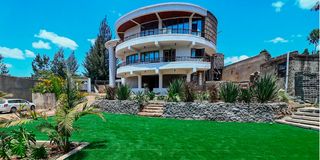
A landscaped play field at businessman Nevy Jackson’s home, dubbed ‘The Mani Mansion,’ in Nkoroi, Kajiado County, on September 5, 2026. Wilfred Nyangaresi | Nation
Photo credit: Wilfred Nyangaresi | Nation Media Group
It cost Nevy Jackson nearly Sh1 million to replace his lawn with artificial turf. After years of watering, weeding, trimming and top-dressing his Pemba grass, the landscaper decided that maintaining a natural lawn was more trouble than it was worth.
The 165-square-metre patch of high-end, European-quality artificial turf now covers part of the compound at his home, which he fondly calls Thee Mani Mansion, in Ongata Rongai, Kajiado County.
The cost covered the turf, shipping, sand, ground preparation and labour, with some of those costs only becoming apparent as the project progressed.
“A square metre, including shipping, costs about Sh3,800,” he explains. “Multiply by about 165, then add the other overheads. It actually comes to almost a million. There are so many hidden costs that I never factored in. But at the end of the day, every day I wake up, I’m just happy looking at my compound.”
Nevy had planted Pemba grass even before he moved into the house. At the time, he was still renting and preparing for the day he would become a homeowner. When he eventually moved into his own space toward the end of 2024, the lawn was already part of the vision he had for the compound.
He had initially chosen the grass with his children in mind. He wanted them to have a comfortable place to play, and a lawn seemed like the obvious choice. But after about three years, the maintenance began to wear him down.
“It was too costly, and mark you, Pemba is one of the cheapest types of grass to care for. It required constant watering, weeding, trimming, top dressing … aah, it was all too much,” he says.
The costs were also difficult to pin down because they kept recurring.
The bigger project
The lawn was only one part of a much bigger landscaping project at Thee Mani Mansion, which sits on one and a half acres. The property is still taking shape, with an area marked out for a fishpond and another for a sunken pool.
At the back of the house is a thriving vegetable and fruit garden, where Nevy grows apples, passion fruits, avocados, pomegranates, bananas, strawberries and lemons. “I have dozens of fruit trees in my garden that I grow organically, and my family eats directly from the farm,” he says.
There is also a gazebo decorated with artificial plants, which Nevy imports and resells from China. “What I love the most about them is that they are aesthetically appealing and there is zero maintenance to them.”
The idea of using artificial grass was therefore not entirely foreign to him. Nevy, who describes himself as “the most creative man alive”, had already installed artificial turf in his primary lounge, where it cost him about Sh2,000 per square metre.
His experience there convinced him to try it outdoors on a much larger scale.But aesthetics was only part of the motivation.
Businessman Nevy Jackson poses for a photo at his home, dubbed ‘The Mani Mansion,’ in Nkoroi, Kajiado County, on September 5, 2026.
Photo credit: Wilfred Nyangaresi | Nation Media Group
Nevy says the decision was also about the time and energy that went into keeping the natural lawn looking the way he wanted it to.
“You assign the caring roles to a trusted gardener, but they mess up at times. You are the bearer of the dream, not them,” he says. “So every so often you get disappointed by the work they are doing on your grass. Sometimes you even get into arguments, and it is just draining psychologically.”
For him, artificial turf offered a way out of that cycle. The upkeep is mainly about sweeping away leaves, particularly in a compound with trees, and occasionally watering the turf to get rid of accumulated dust.
Chirping birds and other concerns
The switch has, however, attracted questions. Some people told Nevy that replacing his lawn would mean losing the birds that visit his compound.
“They used to tell me that I wouldn’t have birds chirping in my compound any longer. But I still have birds chirping,” he says.
There were also concerns about the environmental impact of artificial turf. Nevy points out that the property still has plenty of natural vegetation, including trees, flowers, fruit plants and a vegetable garden.
“Not everyone in my neighbourhood has artificial grass; some still have the real grass, and beyond that, I have lots of trees and flowers in my compound. So I am not in any way jeopardising the environment,” he says.
For many Kenyan homeowners, a green lawn remains an important part of a beautiful home, but Nevy says the effort involved is often underestimated.
“The cost of watering is high. You always have to have someone watering the grass on average four times a week, or even if possible, for some types of grass like Arabica, almost every single day,” he says.
Watering aside, there is weeding, top-dressing, adding soil and manure, trimming and the labour that goes into keeping the lawn healthy throughout the year.
Although artificial turf eliminates much of that work, Nevy cautions homeowners against assuming that every type of artificial grass will deliver the same results.
The turf he installed is expected to last about eight years, while the cheaper version in his lounge should last about five. The difference comes down to quality, thickness and density, as well as where the turf is installed.
The primary sunken lounging area at businessman Nevy Jackson’s home, dubbed ‘The Mani Mansion,’ in Nkoroi, Kajiado County, on September 5, 2026.
Photo credit: Wilfred Nyangaresi | Nation Media Group
“If you're installing it on a balcony, you don't even need that thick quality. But if you're installing it in a high-foot-traffic area, for example, a lounge, a club, that's where you actually need the thicker, denser grass,” he says.
Choosing the cheapest option can therefore prove costly, particularly in busy areas where the turf is likely to wear out quickly.
“You may have noticed that some lounges install artificial grass, but it ends up wearing out so quickly. That's because they went for the cheapest density, the cheapest thickness, thinking they're saving money,” he says. “That grass wasn't meant for that area based on the foot traffic. It might have been perfect on a balcony. That's where people go wrong.”
The biggest mistake
Then there is the question of rain. Nevy says artificial grass itself is not the problem when water pools on the surface. Proper ground preparation is what matters.
“Artificial grass is perforated, meaning water seeps through. But if the ground beneath it does not drain well, the water has nowhere to go,” he explains.
Cotton soil, for instance, can create problems because it does not drain water efficiently. If artificial turf is installed directly on such ground, heavy rain can result in water pooling underneath and muddy patches appearing on the surface.
“The biggest mistake people make is in the preparation before installation,” he says. “So you will assume it's the artificial grass that's holding the water, yet it's your ground that's not permeable enough.”
In some cases, proper preparation requires excavating the existing soil and replacing it with material that drains better. This adds to the installation cost, but Nevy says it is necessary if homeowners want the turf to perform as expected.
The location of the property also matters. Soil conditions in a place such as Gilgil, for example, may require different preparation from an area where the ground retains more water.
A landscaped play field at businessman Nevy Jackson’s home, dubbed ‘The Mani Mansion,’ in Nkoroi, Kajiado County, on September 5, 2026.
Photo credit: Wilfred Nyangaresi | Nation Media Group
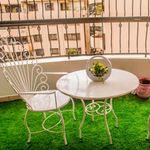
Nevy also sees artificial turf as a practical option for rooftop terraces, which can otherwise be left as bare concrete or terrazzo.
“You can imagine having a rooftop; it's just a huge slab or terrazzo. You can't even use it nicely. But when you have grass, even when you have small kids, it's very friendly, it's aesthetically appealing, and it's more cosy compared to having just a flat slab,” he says.
He believes Kenyans are gradually becoming more open to the idea, despite the initial resistance to replacing natural grass with a synthetic alternative. As more homeowners experiment with artificial landscaping, he says, they are beginning to appreciate its appearance and the reduced maintenance.
Nevy regularly shares landscaping tips and advice on his Facebook profile, including what homeowners should consider before installing artificial turf and the mistakes that can drive up the cost.
For him, the change has been worth it. His fruit trees, flowers and vegetable garden continue to provide plenty of natural greenery, while the artificial turf gives his children a place to play and gives him the low-maintenance lawn he had been looking for.