Time flies with great content! Renew in to keep enjoying all our premium content.
Prime
Paramedic career grows, but young Kenyans struggle with trauma and low wages
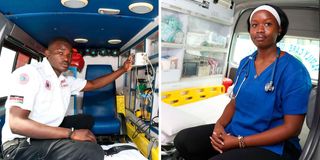
Lawrence Ombwochi (left) and Jackline Amondi, Advanced Emergency Medical Technicians at Impulse Ambulance, during an interview inside an ambulance along Kimathi Street in Nairobi on February 18, 2026.
Paramedicine is attracting younger Kenyans, but some already in the field are considering quitting due to its emotional toll and low wages.
Jackline Amondi, 25, is among them. She is a certified and licensed advanced emergency medical technician (EMT) and has been working for one and a half years now. She remembers her first experience with a patient who died in her care.
“He was a university student studying pharmacology. He was stable and talking to me,” she says during a BDLife interview from an ambulance.
But when they reached the hospital, he suddenly lost all signs of life. “He had no pulse. I tried CPR. There was nothing. This image stays in your mind,” Jackline says.
She says after difficult work schedules, paramedics hold debrief sessions. “We talk about what happened. But it does not help completely.”
When she goes home, sometimes she cries, she admits. “We are told not to get attached to patients, but it is not possible. Some are your age mates, and seeing them lose their lives is not an easy thing to deal with.”
Back in school, she recalls there were 28 students in her class. Today, she only knows of two who are working as EMTs. One of her friends struggled to cope. “He got into heavy drinking because of the traumatic experiences from the field,” Jackline says.
The working hours are also long. Many ambulance agencies run 24-hour shifts. “Most of us work about 15 straight days. The body becomes tired. The mind becomes tired too,” she says.
She hopes to only work for two years, then switch to a different career, but still in medicine.
“I want to study nursing or work as a dispatcher in an ambulance operation centre,” she says, “somewhere I can still serve but with less emotional weight.”
Her story is not different from that of Lawrence Ombwochi. The 22‑year‑old has worked as an advanced EMT for two years, after graduating in 2023 from Med Swift under the Council of Emergency Medical Technicians.
Before joining the field, he says he thought the job “was going to be easy.” “Then you’re got with pressure. You’re the first person to attend to a patient’s life. If you make a mistake, the wrong treatment can be given.”
He, too, faces long shifts, sometimes up to 48 hours. He once worked 14 days in a row, rested for two days, and then went back for another 14 days. “You never know when you get a call,” he says. “Maybe you are about to go home, and then you get a call. You cannot ignore it. Life is waiting in line.”
The pay, he admits, does not match the effort. “We work very hard.”
Sometimes they even use their own money on patients who cannot pay for hospital admissions. “If I register 10 patients, I get broke,” he says.
The emotional weight is also a challenge. “When you’re alone, the flashbacks return,’ he says, remembering a patient who fell from the 10th floor. “I witnessed things I had never imagined.”
His first day in the field, two patients died in one night.
However, Lawrence says he has somewhat found his own way to cope. After long shifts, he goes to the gym for boxing. He also reads novels. “I try to keep my body and mind active so that the memories do not consume me,” he says.
He, too, says he will not stay in the field for long. He wants to leave after four years and become a paramedic trainer. If that does not happen, he will fully shift to boxing.
“I love boxing,” he says. “I have won 16 out of 17 tournaments. This has given me confidence and strength, and I believe I can go far with it.”
Unlike Jackline and Lawrence, Karen Njeri has stayed in the career for over 10 years. But still, the emotional toll weighs deep.
She still recalls the gunfire on her very first day as a paramedic, fresh from school, during the Westgate Mall attack in September 2023.
“I encountered everything on my first day, a welcome into this career.”
At 31, she believes lasting in this career is not about being fearless, it’s about learning how to cope.
“I am an introvert,” she says. “But speaking about difficult calls has helped me stay steady. Having a small circle of trusted colleagues who understand the work has made the difference.”
She worked in an ambulance for eight years before becoming a dispatcher [a person who coordinates emergency medical responses behind the scenes]. “But even now, there are moments I panic,” she admits. “Sometimes a scene reminds me of something painful. I step aside, breathe, and call someone.”
She encourages younger paramedics to recognise when they need rest. “If it becomes too much, take a break. Reflect. Ask yourself if it is still worth it. And if it is not, it is okay to walk away.”
Low pay
The job also comes with financial strain. Despite the responsibility and risk, the pay remains low. “In many private ambulance services, salaries range between Sh800 and Sh2,000 per day, adding up to about Sh24,000 to Sh30,000 per month,” says Melvine Nyagaya, a 28-year-old.
But she hopes for better opportunities, especially in the UAE, where working conditions and salaries are better. “I want to move to the United Arab Emirates, these countries pay well, and the ambulances are well equipped”, she says.