Time flies with great content! Renew in to keep enjoying all our premium content.
Prime
More with less: ‘Why investing in Africa’s food systems is a good bet’
Dr Wanjiru Kamau-Rutenberg, the managing director for Africa at the Alliance of Bioversity International and CIAT, during an interview in Nairobi on August 27, 2026.
Africa Food Systems Forum opens in Kigali, Rwanda today, with delegates, including heads of state, key policymakers, investors and scientists, expected to explore solutions to some of the continent’s major food security problems.
This year’s edition of the annual forum comes amid concerns that the protracted Middle East conflict is exposing the continent’s vulnerability to food and farm input imports, adding to the devastating impact of the climate change.
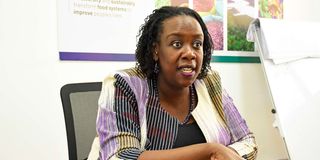
Ahead of the Kigali meeting, the Business Daily spoke with Dr Wanjiru Kamau-Rutenberg, the managing director for Africa at The Alliance of Bioversity International and the International Center for Tropical Agriculture (CIAT), on, among others, what the African governments need to do about the continent’s food systems urgently, why the rest of the world should care about food security in Africa and what they can learn from Africa.
The organisation works with governments, national research organisations, academia, regional bodies, the private sector and farming communities to translate research into real-world solutions.
This must be a special year for you, having been named a 2026 Top Agri-food Pioneer by the World Food Prize Foundation and nominated for the FAO 100 Women Heroines of 2026. What does this recognition mean to you?
It's humbling, and I take it as recognition of a body of work, not a single person. Every institution I've built or led — starting with Akili Dada, then AWARD, then B-WEL, and now the Alliance's Africa programme — has been about proving that African talent, women's talent especially, delivers when it's resourced and trusted. So I see this less as "Wanjiru was recognised" and more as a spotlight on the scientists, breeders, and young women in labs and fields across the continent whose work rarely makes headlines. If this recognition opens doors, I intend to use it to bring more of them into the room.
This week, African leaders, policymakers, decision makers, investors and financiers are attending the Africa Food Systems Forum in Kigali. If you have the attention of African heads of state and other key decision makers, what would you ask them to do about the continent's food systems urgently?
Fund what you've already signed. Governments have committed to CAADP targets for years; the gap now is domestic budget allocation and execution, not more declarations. I'd ask leaders for three concrete things: meet the 10 percent agriculture budget commitment, put real money behind national agricultural research and innovation systems so African scientists can lead their own research agendas, and use AfCFTA to de-risk regional trade in food so a surplus in one country can actually reach a shortage in another. Africa's agriculture doesn't need more pledges. It needs financing that reaches the institutions and people already doing the work.
Looking back at your work in the sector, what are some of the experiences that changed the way you think about agriculture and Africa's role in global food systems?
Founding Akili Dada with young women from under-resourced backgrounds showed me early how much talent gets lost simply because the pipeline narrows long before anyone reaches a lab or a research career. When I later went on to lead AWARD, I saw the same pattern one step further down the line: brilliant African women agricultural scientists producing rigorous, publishable research and still getting passed over for funding and leadership, because the system wasn't built to see them. Together those experiences moved me from thinking about agriculture as a technical problem to thinking about it as a systems and equity problem, which is the lens I bring to the Alliance's work now.
What is the biggest misconception about African agriculture that you would like to change?
That Africa is a food aid recipient waiting to be rescued, rather than a continent of scientists, breeders, and farmers actively solving hard problems — often with fewer resources than anywhere else in the world. Africa holds a large share of the world's remaining arable land and an extraordinary depth of crop and livestock biodiversity. The story isn't scarcity of capability, it's scarcity of investment. Change the financing and you change the narrative.
What does Africa need to do differently to produce the next generation of agricultural scientists and innovators?
Stop treating capacity-building as a side project and fund it as core infrastructure. That means real investment in African universities and national research institutes, mentorship pipelines that start before graduate school, and deliberate attention to gender — because talented women are still exiting the pipeline at every stage. It also means creating career paths at home so we stop losing scientists to systems abroad that simply pay and resource them better. South–South exchange matters here too: a plant breeder in Kenya has as much to learn from a counterpart in Ghana or Vietnam as from one in Europe.
What innovations or research breakthroughs are being developed in Africa that the rest of the world is overlooking?
Climate-resilient crop varieties bred specifically for African soils and rainfall patterns, serious genebank and biodiversity conservation work that will matter to every country's food security as climate change accelerates, and a quiet revolution in women-led agribusiness — aggregation, processing, market linkage — that rarely gets covered but is reshaping how food actually moves from field to table. Layered on top of all of it is the tech revolution: mobile-based advisory services reaching smallholders in local languages, digital and satellite tools for early warning and precision inputs, and AI-enabled research platforms that are compressing timelines that used to take a decade. That combination of biological, market, and digital innovation is what's really driving Africa's agriculture transformation, and most of it is happening under-resourced and under-reported.
Why should the rest of the world care about food security in Africa?
Because food systems are global systems. A shock in one region's supply chain — as Covid and the war in Ukraine both showed — moves prices and availability everywhere. Africa is also home to the world's youngest and fastest-growing population and a large share of its remaining arable land, which makes the continent central to whether the world feeds itself by 2050, not peripheral to it. Investing in African food security isn't charity; it's a rational bet on where global food security will actually be won or lost.
Climate change, conflicts, pandemics and disruptions to global supply chains have exposed vulnerabilities in food systems. What can the rest of the world learn from Africa?
Resilience, largely because African farmers and food systems have had to practice it out of necessity rather than choice. Smallholder farmers have long diversified crops and income sources to manage risk, communities have maintained indigenous and local food networks that don't depend on a single long supply chain, and researchers here have deep experience breeding for drought, pests, and marginal soils. The rest of the world is only now confronting the fragility of hyper-optimised, concentrated supply chains. Africa's food systems, for all their under-investment, were built for shocks from the start. The world has a lot to learn from us.
Do you believe Africa can actually achieve food security and feed the world in future?
Yes, but I want to be precise about what has to be true for that to happen. It requires sustained investment in national research systems, infrastructure that gets food from surplus regions to deficit ones, and financing that reaches farmers and scientists directly rather than getting absorbed in overhead. The tech revolution has tremendous potential of giving Africa a genuine chance to leapfrog rather than simply repeat the path other regions took.
If we invest in it deliberately rather than letting the revolution happen to us. Given the continent's arable land, biodiversity, talent, and this technology moment, Africa can really do this if we choose to. Whether we chose to capture the opportunity that this moment in history presents us is a question of political will and investment discipline, not capability.
Unlock a world of exclusive content today!Unlock a world of exclusive content today!