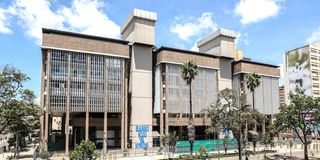
The Central Bank of Kenya (CBK) has been faulted for using an undisclosed equipment requirement to disqualify bidders from a Sh1 billion Kisumu branch upgrade tender.
The Public Procurement Administrative Review Board (PPARB) found that the CBK listed a requirement for bidders to provide manufacturer authorisation matching existing computer room cooling systems by global firm, Stulz, although the brand was absent from the tender documents.
The board said the requirement was "extraneous, undisclosed and brand-specific”, and that CBK could not evaluate bidders against a criterion that was not contained in the tender documents.
The dispute concerned a tender advertised in March 2026 for enhancements and improvements to electrical power systems and associated data-centre works at the CBK Kisumu branch.
Five companies submitted bids, ranging from Sh985 million by Infinity East Africa Company Limited to Sh1.64 billion by Ultra Power Systems Ltd.
Other bidders included Master Power Systems Limited, which quoted Sh1.04 billion, while Masterpiece Electricals Ltd quoted Sh1.17 billion and Central Electricals International Limited quoted Sh1.19 billion.
CBK's evaluation committee eliminated four bidders at the preliminary stage. Central Electricals was the only bidder found responsive and allowed through, and eventually became the recommended winner at Sh1.19 billion.
The procurement watchdog, however, set aside the intended award after Master Power Systems Limited challenged its disqualification, finding that CBK had unlawfully applied an undisclosed, brand-specific requirement for Stulz equipment.
The Board ordered CBK to reinstate Master Power's bid for technical evaluation alongside the other tenders that had passed the mandatory requirements.
At the centre of the dispute was Mandatory Requirement 5 in the tender documents, which required a manufacturer’s letter of authority addressed to CBK, quoting the tender and affirming compliance with the bills of quantities.
For thermal containment air-conditioning, the requirement also required the make and model to be indicated. The Board found that the bills of quantities specified a Vertiv Smart Aisle system, while the precision air-conditioning specifications contained performance requirements without naming Stulz.
The Board found that “Stulz” appeared nowhere in the tender document, Mandatory Requirement 5, technical specifications, bills of quantities or in the addendum No.1.
Yet Master Power’s rejection stated that it had failed to provide manufacturer authorisation “matching existing Stulz”.
Infinity was similarly rejected after submitting a manufacturer’s authorisation from Daikin, rather than an authorisation matching the existing Stulz equipment.
The Board rejected CBK’s explanation that the Stulz reference was inadvertent. It noted that the reference appeared in the evaluation report, professional opinion and notifications issued to the bidders.
“A reason appearing in each of the three instruments, which constitute the formal record of a procurement and applied to more than one tenderer, is not a slip of the pen,” the Board said in its ruling.
CBK argued that compatibility with the existing installation was necessary because the data-centre cooling units had to communicate with one another. Its consultant said six cooling units were installed and three more were planned.
The Board accepted that compatibility could legitimately be required. But it held that CBK had to publish the requirement and could not introduce it during the evaluation of bids.
“The procuring entity is bound by the criteria which it publishes. It may not evaluate against a criterion which does not appear in its tender document,” the Board said.
The Board rejected the argument that bidders could have discovered the requirement during a site visit. The tender provided that failure to attend could not lead to disqualification.
CBK issued an addendum on April 7, 2026, after the March 26 site visit. The bank’s published addendum addressed clarifications on the staircase pressurisation system and confirmed that its actuation mechanism was electric rather than carbon dioxide; it did not introduce a Stulz requirement.
The Board found the Stulz requirement breached Section 80(2) of the Public Procurement and Asset Disposal Act, which requires evaluation using criteria contained in tender documents.
Master Power was therefore found responsive under the published mandatory requirement and reinstated in the evaluation process.
Infinity, however, did not secure reinstatement despite succeeding on the Stulz issue. The Board found separate defects in its bid.
Its average annual turnover was Sh288 million, below the Sh300 million threshold. Its security installer’s certificate had also expired before submission.
The ruling stressed that the lowest quoted price alone does not determine the winner.
The Board also rejected allegations of collusion, bad faith or a premeditated scheme against CBK, finding no cogent evidence supporting them.