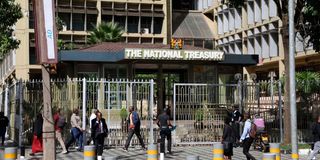
The National Treasury has cleared the way for agencies and counties to procure utility goods and pay bills under the Integrated Financial Management Information System (Ifmis), ending a near three-month standoff that threatened to paralyse operations in government.
The Treasury’s action paves the way for clearance of pending bills and dues related to contracts entered into before July, and allows counties and agencies to pay bills for operations such as water and electricity.
The decision to revert to Ifmis follows a High Court decision on Monday stopping implementation of the electronic government procurement (e-GP) system, amid fierce objections by counties.
In July, the government rolled out the e-GP system to automate public procurement, tracking activities from tender advertisement to supplier payment.
The e-GP was brought to replace Ifmis in procurement matters and take over the role of availing procurement documents from procuring entities, following concerns of loopholes that enabled funding of ghost projects and diversion of approved supplier payments to other uses.
Delays in implementation of the system, however, left counties and agencies stuck as they could not procure anything, sparking rage from governors who claimed that crucial services and projects were blocked.
Treasury Principal Secretary (PS) Chris Kiptoo on Monday wrote to all accounting officers asking them to use Ifmis- a system it had insisted on exiting for procurement activities - for settlement of pending bills, sourcing goods and services, and processing payments for contracts entered before July.
“Accounting officers are advised to process payments for ongoing contracts entered into prior to July 1, 2025 in the Ifmis system. The e-GP system lacks records or data for such contracts as they were processed prior to the July 1, 2025 roll out,” Mr Kiptoo said.
He also asked the officials to process pending bills emanating from procurement undertaken before July on Ifmis, while calling for prompt settlement of verified bills and ongoing contract obligations that have fallen due.
“In addition, in our circular letter referenced above (Ref. No. NT/PPD/1/3/14 TY 3 (68) of July 23, 2025) it was clarified that payment of utilities e.g. water, electricity, rent and telephone expenses shall be processed in Ifmis system in line with Ifmis procedure and not in e-GP,” the PS said.
Mr Kiptoo, however, remained silent on new spending on development projects planned for the current fiscal year, creating confusion for counties and agencies that have now gone for more than two months without any spending on projects.
While public offices have been given a greenlight to procure goods and services that enable their operations, it remains unclear what happens to development projects which are valued at Sh693.2 billion in the year to June 2026.
The more than two-month blockade of procurement activities has disrupted budgets worth nearly Sh250 billion, based on Treasury’s annual procurement spend projection of Sh1 trillion.
The Treasury's new directive is a U-turn from the firm position it held in the past weeks, insisting that agencies and counties must source goods and services through the e-GP, even as delays in implementation of the system hampered operations and delayed projects.
Last Friday, Head of Public Service Felix Koskey asked accounting officers to publish procurement plans on the system by September 19 to pave the way for procurement processes to start, after the Treasury uploaded national government budgets the previous Monday.
“Accounting officers are hereby asked to ensure that their procuring entity's annual procurement plans are finalised and published in the e-GPS portal by Tuesday September 19, 2025 in line with Section 44(2)(i), 53, and 158(2) of Public Procurement and Asset Disposal Act, 2015, to pave way for the subsequent procurement processes, without further delay,” Mr Koskey said.
On Monday last week, governors accused the Treasury of forcing counties to implement the e-GP though it was marred with inconsistencies and had disrupted services in health, agriculture and infrastructure sectors.
“Lack of adequate sensitisation and training has paralysed procurement processes, particularly in critical sectors such as health,” said Council of Governors (CoG) Chairman Ahmed Abdullahi.
Governors said that even in the three counties –Makueni, Elgeyo Marakwet and Busia— where piloting of the e-GP was undertaken, the system failed.
Treasury’s new position allowing agencies to use Ifmis to process pending bills and contract payments, and to source goods and services, is an appreciation of the challenges agencies have faced since July.
On August 12, the Public Procurement Regulatory Authority (PPRA) had warned accounting officers who were procuring goods and services outside the e-GP that they would be surcharged.
PPRA accused unnamed procuring entities of procuring goods and services outside the e-GP platform and backdating procurement proceedings to before June 30, 2025, warning them of stern punishment.
“Effective July 1, 2025, all public procurement and asset disposal transactions should be conducted through the e-GPS, any procurements done outside the system and paid for shall be surcharged on the officer who authorised the transaction,” said PPRA Director-General Patrick Wanjuki.
The PPRA circular also cited a July 23, 2025 Treasury directive that only contracts previously reported to the PPRA would be approved for payment.