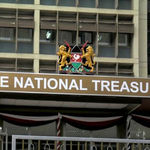
The government’s raised domestic borrowing target for the 2025/26 fiscal year is unlikely to exert fresh pressure on interest rates, the Central Bank of Kenya (CBK) has said, noting that a large share of the projected Sh996 billion has already been tapped.
In its first supplementary budget for the 2025/26 financial year, the government raised the domestic borrowing target to Sh996 billion, up from the initially planned Sh635 billion. This marks an increase of Sh361 billion and has sparked fears of renewed pressure on interest rates.

The revised domestic debt target followed an expansion of the 2025/26 budget by Sh363.9 billion to Sh4.66 trillion, amid a wider revenue shortfall of Sh1.3 trillion. This has prompted heavier reliance on the domestic debt market to plug the gap.
CBK Governor Kamau Thugge said the risk of upward pressure on interest rates has been mitigated by front-loaded borrowing in the first three quarters of the financial year.
“The borrowing target in the supplementary budget is about Sh996 billion, while the original budget had a target of Sh635 billion, and so there is a significant increase. However, as we speak today, we are already at about Sh850 billion worth of domestic borrowing, and so it’s only about Sh150 billion that is pending,” he told Business Daily in an interview.
“I believe with that, we can meet that borrowing target without adding a lot of pressure on interest rates,” the CBK boss added.
Interest rates have generally been on a downward trend, with the average commercial bank lending rate falling from a peak of 17.22 percent in November 2024 to 14.8 percent at the end of February 2026.
This steady decline has been supported by the CBK’s prolonged monetary easing cycle. The benchmark rate has dropped from 13 percent at the start of 2024 to 8.75 percent as of April 8, 2026, a decline of 425 basis points aimed at boosting credit to the real economy.
In March, private sector credit grew by 8.1 percent, marking 13 consecutive months of expansion after emerging from negative territory in the first quarter of 2025. It has been three years and two months since credit growth last hit double digits, with the previous instance recorded in February 2023 at 10.3 percent.
The CBK said it remains focused on supporting private sector lending in the near term, despite rising inflation and foreign exchange pressures linked to the US-Israel war with Iran and the resulting constraints on monetary policy flexibility.
“At this point, the yield environment should not be a challenge because most of the borrowing has been done already, and what remains should not put too much pressure. Since August 2024, we have been on a monetary easing cycle because, in a sense, we had achieved our key mandate of stabilising prices and the exchange rate, and we needed to stimulate growth through credit to the private sector. We still believe there is more room for credit expansion,” Dr Thugge said.
Kenya’s inflation rose to 4.4 percent in March, reversing the slight easing recorded in February and signalling renewed pressure on household budgets.
The increase returned inflation to levels last seen in January 2026, with expectations of further rises as the impact of the Middle East crisis feeds through to higher prices of petroleum and other key imports such as fertiliser.
In the latest pump price review cycle to May 14, 2026, the price of super petrol rose by Sh19.32 to Sh197.60 per litre, while diesel increased by Sh30.09 to Sh196.63 per litre.
“There could be some offsetting dynamics on the inflation numbers. If you look at the March numbers, which rose to 4.4, the main driver was non-core inflation and, more specifically, food inflation. However, weather conditions have been favourable, and it is possible that food inflation will reverse in April and May. So, in the June Monetary Policy Committee meeting, one of the things we will be looking at is non-core inflation and whether the increase in fuel prices will have been offset by a decline in food prices,” Dr Thugge said.