State warns of looming food shortage on escalated rice import row

Rice storage

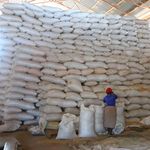
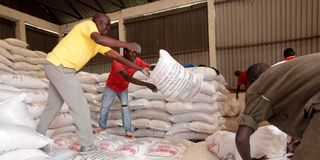
Workers arrange bags of rice at a storage facility in Ahero.

Photo credit: File | Nation Media Group

The government now claims that blocking duty-free rice imports would worsen Kenya’s looming food crisis, with national stocks projected to run out by the end of this month leaving over 3.5 million people at risk of hunger if emergency measures are halted by the courts.

Court documents filed by the Ministry of Agriculture and other state agencies reveal an urgent need for approximately 750,000 tonnes of rice between January and June 2026, while only 110,000 tonnes remain in reserves. Officials argue this shortfall cannot be addressed through local production alone.
The warning forms part of the state’s defense in a High Court case in Kerugoya, where the government seeks to uphold a July 28, 2025, Gazette Notice authorising duty-free imports of 500,000 tonnes of Grade 1 milled white rice as a food security measure.

The case challenges the notice’s constitutionality, filed by Kirinyaga Senator Kamau Murango and Baragwi Ward Representative David Mathenge.

Initially, the importation was set to continue until December 31, 2025, but the court temporarily restricted imports to 250,000 tonnes pending the case’s resolution. The petitioners argue that unrestricted imports would harm local farmers, retailers, and suppliers holding existing stocks, potentially causing financial losses.

They dispute the government’s claim of an “anticipated shortfall,” alleging insufficient efforts to purchase local harvests over three seasons.

“This is not true because the 2nd and 3rd respondents (Cabinet secretaries for Treasury and Agriculture) cannot claim famine when they have not completely mopped up and/or purchased local harvest as alleged at the paddy for three seasons,” says the petitioners.

Court filings indicate that by November 2025, available national stocks stood at 381,225 metric tons, a level the state says was already inadequate against rising consumption and climate-driven production shocks. A ruling is expected on January 29, 2026.

Without imports, the Attorney-General’s counsel warned the court that stocks would be depleted by the end of January 2026, exposing millions to food shortages.

The State counsel told the court that rice is no longer a luxury but a staple for millions of households, especially in urban areas and food-deficient counties.

National demand stands at between 1.3 and 1.5 million metric tonnes annually, while domestic production supplies less than 20 percent of that requirement.

“Localized surplus cannot be mistaken for national food security,” the State argued, cautioning against relying on pockets of availability in schemes such as Mwea to assess national needs.

The pressure is being compounded by adverse climate conditions. Seasonal forecasts presented to the court show erratic and below-average rainfall across key food-producing regions, including the Northeastern corridor, the Coast, parts of the Rift Valley, and western ASAL counties.

Irrigated schemes such as Mwea, Ahero, and Bunyala are facing reduced water availability, while rain-fed areas have suffered failed planting seasons. The government said these shocks have disrupted planting calendars and sharply reduced yields.

The human cost of delayed action featured prominently in the submissions. By November 2025, about 1.8 million people in ASAL counties were already experiencing high levels of acute food insecurity.

Without timely intervention, that number is projected to rise to more than 3.5 million, a scenario the State described as “real, imminent, and disproportionately borne by vulnerable populations.”

The court had previously allowed the importation of 250,000 tonnes of rice on a temporary basis, pending the resolution of the dispute.

In its latest filings, the government is seeking permission to import a further balance under strict controls, arguing that the earlier consignments only “scratched the surface” of market demand and helped dampen price volatility towards the end of 2025.

The state counsels warned that blocking imports would drive up rice prices, hurting low-income households in informal settlements and drought-affected counties, where food takes up the largest share of household income.

When rice becomes unaffordable, families shift to maize, pushing up maize prices and triggering a cascading food inflation effect across the entire system, the court was told.

The Ministry denied claims that duty-free imports undermine local farmers. It said the Kenya National Trading Corporation (KNTC) has been mopping up locally produced rice since 2020, purchasing from cooperatives in Mwea, Ahero, Bunyala, Kuja, Kano, and Bura for redistribution to public institutions.

Even so, the State insisted that full absorption of local stocks cannot bridge the national deficit or stabilise prices countrywide.

At the heart of the dispute is the Constitution’s guarantee of the right to food. The government anchored its defence on Articles 21 and 43, arguing that the State is obliged to take anticipatory, evidence-based measures to prevent hunger rather than wait for crisis to unfold.

It urged the court to exercise restraint where executive action is lawful, rational, and taken in good faith to protect socio-economic rights.

While acknowledging concerns raised by the petitioners, the State argued that the interests at stake go beyond commercial disputes.

“The court is being asked to weigh competing interests,” government lawyers submitted. “On one side are private and commercial concerns; on the other are the livelihoods, dignity, and survival of millions of Kenyans.”

PAYE Tax Calculator

Note: The results are not exact but very close to the actual.