State eyes asset sale relief as Kenyans reject more taxes

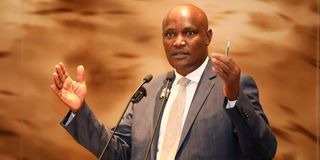
Treasury Cabinet Secretary John Mbadi speaks during treasury market update at JW Marriott Hotel in Nairobi on December 4, 2025. 

Photo credit: Bonface Bogita | Nation Media Group

The government has rolled out a plan to sell its stake in several commercial public corporations as part of a new framework for funding future public projects.

In the pipeline for privatisation are more than 200 state-owned enterprises (SOEs) and other companies where the State has ownership stakes, with 45 of the entities lined up for the first phase of divestiture.
Already, Safaricom and the Kenya Pipeline Company (KPC) have been marked as prototypes for this initiative, with Safaricom expected to generate Sh244.5 billion and the KPC Sh100 billion.

The government plans to use proceeds from the sale of SOEs to de-risk commercially viable public projects, allowing the private sector to inject cash into the projects rather than borrowing or taxing Kenyans more.

“These are innovative ways of raising funds to finance our infrastructure projects without more debts and without taxing Kenyans more, because that is not an option” Treasury Cabinet Secretary (CS) John Mbadi says.

“We are thinking strategically, and we are taking off many projects from our budget to free it and create more fiscal space. Going forward, the fiscal distress will reduce,” he adds.

Flawed idea

Treasury has pitched the sale of public assets and use of the proceeds to attract investments from the private sector as a viable alternative to borrowing more and raising taxes.

According to Mr John Mutua, the Programmes Coordinator at the Institute of Economic Affairs (IEA), the State’s idea is flawed as it seeks to address long-term issues, when the government is currently faced with cash flow challenges, it is struggling to maneuver.

“The proceeds of privatisation would be more impactful if used to cushion the government, since currently much of the taxes are going to paying debt and salaries. Selling public assets to invest is not the best idea,” Mr Mutua says.

His views come at a time when the Parliamentary Budget Office (PBO) observes that, faced by missed revenue targets after attempts to introduce new taxes flopped, the government has been forced to eat the humble pie and chase after parties currently not paying taxes.

The Kenya Revenue Authority missed revenue targets by Sh205 billion in the 2023/24 fiscal year, and by Sh137 billion in the year to June 2025, a sign that the country is no longer yielding more taxes from the same group.

“In the FY 2025/26, the government has proposed a less ambitious target of collecting Sh30 billion through the amendment of various tax measures through the Finance Act, 2025. The Act marked a strategic shift from previous tax amendment laws since, instead of imposing new tax burdens, it focuses on strengthening revenue collection through administrative reforms and improved taxpayer compliance,” the PBO says.

President William Ruto also says only the framework of blending proceeds from the sales with capital from the private sector can sustainably drive his investment ambitions in roads, energy, agriculture, and other infrastructure.

He says that by putting the proceeds of privatisation into a proposed National Infrastructure Fund (NIF), the State is confident to attract up to 10 times the proceeds from the private sector for projects across health, agriculture, roads, and energy sectors.

“For every shilling invested from privatisation proceeds, we aim to attract Sh10 from long-term investors, drawn from pension funds, sovereign partners, private equity, and development finance institutions. This multiplier will allow us to build critical infrastructure without adding to the tax or debt burden,” President Ruto says.

Sh5 trillion target

The government hopes that eventually, up to Sh5 trillion will be generated through this model and invested in projects.

At the Privatisation Commission, the government has marked 207 entities from which it plans to withdraw its stake. These are the companies the State considers non-strategic, and among the 45 in the first phase are KPC, East African Portland Cement, Kenya Airways, Kenya Reinsurance Corporation, Kenya Wine Agencies, National Bank of Kenya, Housing Finance Company of Kenya, and Bamburi Portland Cement.

One Nairobi-based financial analyst, however, observes that it would have been more prudent for the State to use proceeds of the sale of SOEs to plug the yawning budget deficits.

The analyst who works for an infrastructure fund also expresses fears that interest rates demanded by investors through the proposed funding framework could be high and end up making the projects more expensive for users.

While the State promises that the funding framework will prevent it from introducing more taxes and borrowing too much for projects, Treasury projections show that the government could borrow a trillion shillings in the coming fiscal year.

Sh1.017 trillion deficit

The 2025 Budget Review and Outlook Paper (Brop) projects that with a Sh4.6 trillion budget against Sh3.58 trillion in projected revenues, Treasury will have to borrow Sh1.017 trillion.

“The resulting fiscal deficit, including grants of Sh1,017.6 billion in FY 2026/27, will be financed by a net external financing of Sh241.8 billion and a net domestic financing of Sh775.8 billion,” the Brop states.

Treasury has said that it also plans to expand the tax base by roping in the informal sector and other taxpayers who have been outside the tax bracket, acknowledging that it has run out of space to raise rates for existing taxpayers.

In the Medium-Term Revenue Strategy, Treasury had indicated the possibility of lowering some of the taxes and introducing others, including the motor vehicle circulation tax, though this has not happened yet.

“The moment we bring more people into the tax-paying bracket, we will definitely go a step further and lower the tax rates to individual clients,” says CS Mbadi.

Follow our WhatsApp channel for the latest business and markets updates. 

PAYE Tax Calculator

Note: The results are not exact but very close to the actual.