Time flies with great content! Renew in to keep enjoying all our premium content.
Prime
Stalled Uhuru-era Nandi dam revived at triple the cost
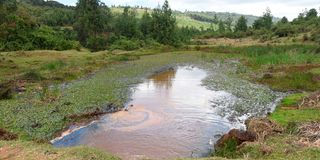
A section of river Talal River in Keiyo-South Constituency, Elgeyo-Marakwet County on December 18, 2021, part of the area that could have been submerged by the construction of Kimwarer Dam.
The long-stalled multi-billion shillings Keben dam project in Nandi County, which was abandoned during former President Uhuru Kenyatta’s era, will be revived by a Chinese contractor at nearly triple the initial cost after the government expanded its design and water treatment capacity.
Procurement records show that SINOHYDRO Corporation Limited has won the contract to construct Keben Dam Water Supply Project, breathing life into a scheme that was shelved in 2019 following the fallout between former President Kenyatta and his then deputy, William Ruto.
The project will involve construction of a 43-metre-high earth-filled dam and a water treatment plant with a daily production capacity of 26,715 cubic metres, supplying drinking water to Nandi Town and surrounding urban and peri-urban centres.
"The project will primarily benefit the residents of Chesumei, Nandi Central, Nandi East and Nandi South sub-counties, with a particular focus on urban and peri-urban areas," Lake Victoria North Water Works Development Agency said in a disclosure.
The revival marks a dramatic transformation of a project first unveiled in May 2017.
At the time, the government estimated the cost at $56.1 million—equivalent to about Sh5.8 billion at the prevailing exchange rate—for the construction of a relatively modest 12-metre-high concrete dam and a water treatment plant capable of producing 8,000 cubic metres of drinking water a day.
Under the newly awarded contract, however, the scheme has evolved into a much larger undertaking.
The dam has been redesigned into a 43-metre-high earth-filled structure—more than three times the original height—while the treatment plant's daily capacity has increased to 26,715 cubic metres, also more than tripling the initial output.
The expanded scope has pushed the contract value to Sh23.6 billion, nearly three times the last publicly disclosed estimate of Sh7.8 billion, reflecting the substantially larger storage infrastructure and treatment capacity rather than inflation alone.
The project will be implemented under the Engineering, Procurement, Construction and Financing (EPC-F) model, under which the contractor will finance, design, build, operate and maintain the dam before selling treated bulk water to the government.
In return, the State will provide land, secure statutory approvals, guarantee bulk water purchases through "take-or-pay" commitments and offer agreed government support measures, including viability-gap funding where necessary.
The arrangement is anchored on a Water Purchase Agreement that allocates risks between the government and the private investor, while making the project bankable. The model is designed to reduce the immediate financing burden on taxpayers while allowing investors to recover their capital over the project's operational life.
Ironically, it was this financing model that thrust Keben into the national spotlight.
It was among 24 dam projects suspended by Parliament in 2019 at the height of the Arror and Kimwarer scandal after lawmakers questioned the EPCF model, describing it as a potential conduit for inflated costs and poor value for taxpayers.
The National Assembly Committee on Environment and Natural Resources halted the Sh188 billion programme and called on the Directorate of Criminal Investigations and the Ethics and Anti-Corruption Commission to investigate how the projects had been procured and whether due diligence had been undertaken.
MPs also raised concerns delayed land compensation, arguing that contractors were receiving substantial advance payments while affected communities were yet to be compensated. The then committee chairman Kareke Mbiuki described the EPCF model as "a complete rip-off", saying it exposed Kenya to expensive borrowing without adequate safeguards.
Keben was suspended alongside several other flagship water projects, including Mwache, Lessos, Soin-Koru, Maragua IV, Bute, Bosto, Gatei and Isiolo, as scrutiny intensified over the procurement of the controversial Arror and Kimwarer dams.
The suspension coincided with the deterioration of relations between President Kenyatta and Deputy President Ruto. The project continued to gather dust on the shelves until Ruto became President.
Soon after President Ruto assumed office in September 2022, leaders from Nandi County mounted a fresh campaign to revive the project, arguing that residents had been unfairly denied a transformative investment because of politics.
Governor Stephen Sang, together with Members of Parliament from the county, urged the new administration to resurrect the dam, saying it would address chronic water shortages, support irrigation, supply tea-growing zones and improve access to clean water for more than 300,000 households in Nandi Hills, Kapsabet and neighbouring towns.
They accused the previous administration of freezing the project during the Jubilee political fallout and appealed to President Ruto to complete projects that had stalled in his political backyard.