Ruto’s pet projects post mixed performance

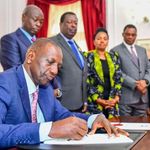
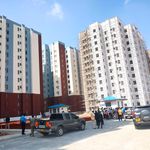
President William Ruto congratulates the new homeowners of Machakos Town Affordable Housing Phase 1, featuring 220 units built at KSh541 million, alongside Deputy President Kithure Kindiki.

Photo credit: PCS

President William Ruto’s pet projects across housing, financial services and health sectors are shaping up in different ways, shedding some light on their fate three years into his administration.

The President in 2022 pitched his Affordable Housing Programme (AHP), Universal Health Coverage (UHC), Digital Superhighway and the Hustler Fund as what would propel his ambition for the country, in a bid to achieve an economic turnaround.
Three years on, a review of the programmes reveals mixed performance where some of the targets have been hit while others are treading a bumpy road.

Economists reckon that while in some of the projects the State has made positive strides, it missed the mark on some from the beginning despite committing billions of public funds.

In the AHP, the government had initially promised to deliver 250,000 houses annually before it reduced the target to 200,000. Even then, the achievement of this target has proved impossible with less than 10,000 houses completed so far.

In the latest budget documents under review by Treasury, the State Department for Housing notes that 2,075 houses had been completed under the programme by June 2025, blaming delays on litigation issues experienced until last year, and the lack of a law to use the Housing Levy initially.

“The AHP completed 2,075 housing units across various counties, including 605 in Bondeni, 1,080 in Mukuru, and several institutional and prison units, while ongoing projects include 62,123 affordable on average of 32 percent, 44,803 social on average of 17 percent, and 11,527 institutional housing units at 22 percent completion level,” the state department said.

The government has completed more houses after that, including 4,536 units opened by the President on December 18.

During the State of the Nation address last month, the President said the construction of 230,000 affordable homes was ongoing across the country, with about 428,000 persons employed.

The government has since reviewed its housing target aiming to deliver 500,000 houses by June 2029, though it remains unclear how it will achieve the new target considering it would need to complete 124,000 houses annually starting July this year.

In the health sector, the government promised to provide health services to all Kenyans, though it has experienced challenges with the rollout of Social Health Insurance Fund (Shif), which was introduced to replace the National Health Insurance Fund (NHIF).

Cases of patients whom hospitals have rejected on the basis that Shif could not cover their treatment have been rampant, hospitals struggling with cash flow issues since they are owed by the State have cropped up, and fraudulent activities continue just as with the defunct NHIF.

“The introduction of Shif was a good idea to ensure provision of health services to Kenyans, though implementation has had challenges," observes John Mutua, the Programmes Coordinator at the Institute of Economic Affairs (IEA).

"The number of Kenyans contributing to the fund are so low and so this has limited the services being offered, while hospitals are also struggling to get their claims paid, running into cash flow and operational challenges," he adds.

Mr Mutua reckons that Kenya’s high informal sector and high poverty levels are major factors why operations of the Social Health Authority (SHA) have had challenges in the early days, since just 4.9 million of the 27 million registered Kenyans are contributing.

As long as the funding gap persists, the economist observes, hospitals will continue to struggle and hinder the programme from achieving the targeted universal health coverage.

Positive strides have, however, been made in some of the digital superhighway targets, including the automation of more than 22,000 public services that are now accessible on e-Citizen, eliminating the need for Kenyans to travel physically to get some of the services at public premises.

The automation of services, which came with rollout of a single account for collection of payments for public services, has seen the government grow its revenues from offering services, after it sealed loopholes previously used to siphon public funds.

A plan to install 20,000 kilometres of fibre optic cables, however, remains far off the track. Government documents show that only 345km of fibre optic cable had been installed along Eldoret-Nadapal by June, with a plan to install 180km delayed due to late clearance from the World Bank.

On the dream to provide affordable credit to young Kenyans to run businesses through the Financial Inclusion (Hustler) Fund, the government has also had mixed results, with default rates rising and risking sinking billions of shillings pumped into the programme, though some of the borrowers have been successful at saving and getting high credit that can sustain businesses.

Micro, Small and Medium Enterprises (MSME) Principal Secretary Susan Mang’eni says more than 700,000 of the 27 million borrowers from Hustler Fund are currently accessing loans of up to Sh150,000, after repaying loans in good time.

“Those ones have borrowed Sh9.3 billion for the last one year since we rolled out the bridge loan product and they have repaid Sh8.1 billion. This is despite the fact that their loan product is long-term so it shows that repayment is not an issue to them,” PS Mang’eni says.

While quite a number of borrowers have been supported by the product, the MSME department notes that just a third of the 27 million borrowers have been repaying, with the remaining 18 million having defaulted.

PAYE Tax Calculator

Note: The results are not exact but very close to the actual.