Kenyans will be allowed to access a portion of their pension savings early for needs such as education, housing, and medical bills under fresh proposals aimed at encouraging the uptake of retirement products.
The Retirement Benefits Authority (RBA) has proposed that part of the pension savings be channelled into a separate account that can be accessed during economic hardships and for investment purposes.
The proposals, dubbed the “two-pot” pension policy reform, is meant to support long-term retirement savings while offering flexibility to help fund members in financial distress.
Currently, members can access their pension benefits, including the matched employers’ contributions, before the early retirement age of 50 if unemployed or when changing jobs.
However, financial hardship is not currently recognised as a legitimate reason for accessing a pension before the retirement age.
The RBA proposals, however, will only allow savers to dip into their pension pots for contributions that will come after approval of the plan.
This means that the restrictions on early access will continue to apply to savings before the proposals are approved and come into force.
The RBA’s “two-pot” pension policy reform borrows from South Africa, which in 2024 allowed savers early access to part of their retirement funds if they are facing acute financial hardships.
“The subaccounts enable members to access a portion of their savings to meet short-term financial needs. This value proposition is an incentive that is expected to encourage uptake of retirement products, particularly by the informal sector,” the RBA said in sector proposals.
“The introduction of sub-accounts will make pension schemes more competitive compared to other savings products.”
Subaccounts or separate accounts will host funds that will hold pension funds that can be accessed early.
For instance, if a worker contributes Sh15,000 monthly for pension savings, Sh3,000 from the contributions can be placed in the subaccount.
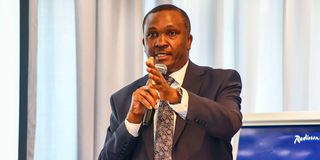
“Your employer may decide that from your 7.5 percent gross salary contribution to the occupational scheme, five percent of this would go into the pension portion while 2.5 percent goes into the subaccount,” said Charles Machira, the RBA chief executive officer.
Schemes, with the approval of the RBA, will be allowed to decide the portion of contributions that will be channelled to the subaccount.
The RBA reckons that returns from some pension schemes are outperforming the investment classes like government securities, banking savings and money market funds (MMFs).
In South Africa, retirement contributions have been split into a savings component and a retirement component.
A ratio of one-third of total contributions go into the savings component and two-thirds into the retirement component.
The savings component will be accessible at any time, but withdrawals must be a minimum of 2,000 rand (Sh16,000) and only one withdrawal may be made in a tax year.
What is withdrawn will be taxed at the individual’s marginal tax rate, helping to boost the government’s tax take.
Within a month of introducing the early access pension plan, South African pension funds paid out $1.2 billion (Sh154.8 billion). Critics acknowledge the potential pitfalls of granting early withdrawals, including reducing later life savings and the adverse impact of releasing lump sums could have on means-tested benefits.
Proponents reckon there is a need for retirement benefits contributors in acute financial hardship to access money from their pensions, including to pay for overseas medical care or avoid property auctions.
The fresh proposal by the RBA has come amid pressure from Kenyans to have some form of access to pension savings before retirement in tough economic times.
The regulator is also under pressure to meet its own mandate of preserving adequate savings for retirees.
The RBA will allow trustees of the various pension schemes to determine the number and uses of funds under the “two-pot” pension plan.
“There is consensus that members would want to have access to some of their savings. We still want to ring-fence the larger proportion of contributions,” said Mr Machira.
“If you have saved Sh5 million today, we are still proposing limiting this access to ensure that at any given point within your working life, you cannot access 70 percent of your money.”
The RBA is pushing to stop workers from accessing their pension savings before age 50 through changes aimed at building a decent retirement nest egg.
The regulator last year advised the Treasury to delete part of the law allowing workers under 50 to access half of their pension benefits when they change jobs.
It sees the pension industry as more than just a savings scheme for retirement and is betting on superior returns from schemes to encourage other forms of savings within the ecosystem.
“We want to make the pensions sector competitive so that young people can also participate. This change will resonate with the GenZs who could be saving to buy a house or a car,” said Lazarus Keizi, the director of research, strategy and planning at the RBA.
The National Social Security Fund (NSSF) is also pushing for a change of law allowing members early access to part of their pension contributions in the State-backed fund.
It wants the NSSF Act, 2013 amended and aligned to the pensions law that allows contributors to access half of their retirement benefits before attaining 50 years.
Kenya suffers from low pension coverage, with more than 70 percent of workers retiring without a pension, save for the previously less than sufficient payout from the NSSF.
Kenyans, on average, are living longer and the rank of the elderly poor is rising as the traditional social fabric yields to the forces of rapid urbanisation and changing social and family trends.
In the past, social security was not a bother to many Kenyans because there was a large extended family to fall back on in the rural areas, but as the social fabric changes and more people opt to retire in urban centres, the trend is increasingly becoming a headache to policymakers.
This is what prompted the State to start a monthly stipend of Sh2,000 for those above 70 years to cushion them from old-age poverty.