Quality fears in TVETs as tutor shortfall hits highly technical courses

Photo credit: Compiled by John Waweru | Designed by Stanslaus Manthi

Kenya’s technical training system is facing a growing imbalance, with highly practical courses hosting far more students per tutor than recommended, raising concerns over training quality and workforce readiness.

Data from the Public Service Commission (PSC) indicate that student-to-trainer ratios vary significantly across course categories, suggesting inefficiencies in the deployment of instructors across Technical and Vocational Education and Training (TVET) institutions.
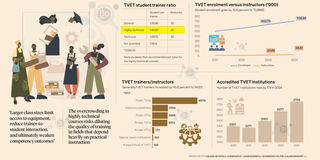
The trainer-student ratio refers to the number of students for every trainer in a TVET institute. The trainer-student ratio reflects the workload on tutor and their availability to the students.

A trainer with fewer students can work more with each of the students, leading to positive outcomes.

Highly technical courses — which require the most hands-on instruction — are operating at 41 students per trainer, significantly above the recommended 25.

In contrast, general courses have about 21 students per trainer, far below the recommended 50, suggesting excess teaching capacity in non-technical fields.

Technical programmes fall closer to the benchmark at 30 students per trainer, though still slightly above optimal levels.

The divergence highlights a structural imbalance in Kenya’s skills pipeline, at a time when policymakers are betting on TVET institutions to support manufacturing, construction and infrastructure development.

The overcrowding in highly technical courses risks diluting the quality of training in fields that depend heavily on practical instruction, such as engineering trades and industrial skills.

Larger class sizes limit access to equipment, reduce trainer-to-student interaction, and ultimately weaken competency outcomes — a concern for employers already grappling with skills shortages. At the same time, general courses appear to be absorbing a disproportionate share of trainers relative to student demand.

With nearly half the recommended student load per instructor, institutions are deploying resources in areas that are less aligned with labour market needs, raising questions about efficiency and workforce planning.

The imbalance suggests that while Kenya has expanded access to TVET education, it has been less successful in aligning training capacity with economic priorities.

The findings come as the government seeks to position Kenya as a regional industrial hub, with bigger focus on value addition, manufacturing and infrastructure.

However, the skew toward general training risks producing graduates who are less equipped for technical roles, forcing employers to invest in additional on-the-job training.

The result is a widening gap between skills supply and industry demand, particularly in sectors that rely on specialised technical expertise.

Analysts say addressing the imbalance will require a reallocation of trainers toward technical disciplines, alongside targeted investment in facilities such as workshops and laboratories.

Follow ourWhatsApp channel for the latest business and markets updates.

PAYE Tax Calculator

Note: The results are not exact but very close to the actual.