Time flies with great content! Renew in to keep enjoying all our premium content.
Prime
Kenya’s foreign missions revamp under PPP starts
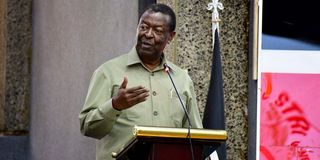
Prime Cabinet Secretary and Cabinet Secretary for Foreign and Diaspora Affairs Musalia Mudavadi makes his remarks during the Science, Technology, Research and Innovation (STRI) Week held at the Kenyatta International Conference Centre on May 22, 2026.
Photo credit: Francis Nderitu | Nation Media Group
The government has kicked off the planned facelift of its diplomatic missions in six African countries under a public-private-partnership (PPP) arrangement, as part of a policy shift aimed at easing reliance on Exchequer funding.
The State is already recruiting a transaction advisor to guide the initiative by undertaking feasibility on the appropriate financing models for the projects and set rental income levels.
“The transaction advisor shall develop robust and auditable project finance models for each project site and a consolidated portfolio financial model covering all sites,” the State Department of Foreign Affairs said in a tender call.
As part of a policy shift, Kenya targets a new arrangement whereby private investors will build, rehabilitate, and maintain diplomatic properties in Cairo, Lusaka, Harare, Bujumbura, Juba and Kinshasa under the PPP model.
The works will entail the construction of purpose-built chanceries, consular halls, ambassadorial residences, and staff housing units.
Investors will design and finance the construction of the properties, then maintain them over a concession period to recoup their money before handing them back to the government of Kenya.
Most of these missions continue to grapple with funding cuts from the Exchequer, hurting efforts to give them a facelift. Workers in these missions have also faced delayed salary payments.
The project sites and properties are expected to consist of two types of developments: income-generating properties, which are mixed-use developments, trade centers, residential and commercial centres, and lease-to-own properties-chanceries, official residences, and staff housing.
The upcoming works at the diplomatic missions in Africa are the latest project where Treasury has turned to the PPP model in a bid to deliver projects without burdening the Exchequer or incurring fresh debt.
The PPP model has delivered the Sh86.8 billion Nairobi Expressway, the 35Megawatt (MW) Sosian Menengai geothermal power Plant, the Galana-Kulalu (Nafaka) Food Security Project, and roads across several counties.
Other PPP-funded projects currently underway are the 233-kilometre Nairobi-Nakuru-Mau Summit Highway, two geothermal power plants each of 35MW, being developed by Quantum and OrPower 22 in Menengai, and 3,069 residential units for the Kenya Defence Forces.