Kenya risks China suit, fines for revealing SGR deals

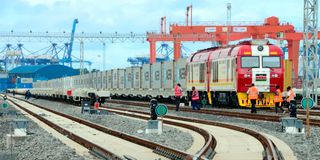
A cargo SGR train at the Port of Mombasa. Kenya’s trade deficit with China hit Sh475.6 billion in 2025 as imports outpace falling exports.

Photo credit: File | Nation Media Group

Kenya faces legal suit, diplomatic fallout and financial penalties from China after courts ordered disclosure of confidential standard gauge railway (SGR) contracts and loan agreements.

The Court of Appeal last week upheld a ruling compelling the government to release secret documents tied to the $4.5 million (Sh580.5 billion) Mombasa-Nairobi railway project.
State lawyers repeatedly warned the courts that exposing the documents to public could breach confidentiality clauses signed with Chinese entities, damage bilateral relations with Beijing and trigger serious contractual repercussions for Kenya.

The warnings emerged in a landmark legal battle over access to SGR records financed through more than $4.5 billion in loans from China Exim Bank and backed by Kenyan taxpayers.

The Court of Appeal last week dismissed the Attorney-General’s bid to block disclosure of the documents and upheld a May 2022 High Court ruling ordering the release the agreements.

Export-Import Bank of China and China Exim Bank had signed confidentiality clauses with Kenya to keep its loan terms secret. Their publication in line with the Court of Appeal order will violate the agreements’ confidentiality clauses in what risks straining relations between Kenya and its largest trading partner.

The ruling now threatens to reshape how Kenya negotiates future government-to-government infrastructure deals, sovereign loans and public-private partnerships involving foreign financiers.

Government lawyers told both the High Court and the Court of Appeal that the contracts contained strict non-disclosure clauses and that releasing them could expose Kenya to “serious legal and financial repercussions”.

In filings before the courts, the State argued that disclosure could undermine Kenya’s foreign relations with China, prejudice commercial interests of foreign parties, affect ongoing litigation and harm the government’s ability to manage the economy.

The Attorney-General further argued that the agreements involved foreign government information with implications on national security and diplomatic relations.

The legal dispute was triggered by transparency activists Khelef Khalifa and Wanjiru Gikonyo, alongside the Katiba Institute, who sought detailed records on the financing, procurement, construction and operation of the SGR project.

Their requests targeted virtually every major agreement tied to the railway project launched in 2014 under former President Uhuru Kenyatta’s administration.

The activists demanded contracts for feasibility studies, financing arrangements, construction agreements, procurement records, concession deals, loan guarantees and collateral agreements linked to the railway.

They also sought copies of the controversial take-or-pay agreement between Kenya Railways and Kenya Ports Authority, operational contracts involving Africa Star Railway Operation Company Limited and agreements tied to the management of Container Terminal Two at the Mombasa port.

Additional requests covered strategic environmental assessments, environmental and social impact studies, cultural heritage assessments and detailed cargo statistics from the Port of Mombasa, Inland Container Depot facilities and the Naivasha dry port.

The petitioners also sought registration and ownership records of Africa Star Railway Operation Company, the Chinese-linked firm contracted to operate the SGR and reportedly paid more than Sh1 billion monthly in operational costs, including details of its shareholders and shareholding structure.

In court filings, the activists argued that the public remained unaware of the full financial obligations Kenya assumed under the Chinese-funded railway project despite taxpayers servicing the loans.

They also pointed to previous court findings declaring that aspects of the SGR procurement process violated procurement laws and constitutional requirements on public participation.

The State, however, maintained that disclosure would violate contractual obligations entered between Kenya and China.

In one response cited by the courts, the Deputy Solicitor-General warned that the documents could not be released because disclosure “might have serious legal and financial repercussions”.

The Principal Secretary for Transport also argued that releasing the records could cripple the government’s ability to implement its integrated national transport policy.

Government lawyers further claimed the disclosures could substantially prejudice commercial interests of foreign governments and financiers involved in the project.

However, the Court of Appeal rejected those arguments, saying the State failed to demonstrate with evidence how disclosure would threaten national security or economic interests.

“The public interest in transparency, accountability and oversight of public finance outweighed any speculative harm alleged by the State,” the judges ruled.

The court further held that secrecy clauses in government contracts could not override constitutional rights on access to information.

“Access is the rule; secrecy the exception that must be earned by the State,” the judges said, in the case that involved conflict of State-to-State confidentiality clauses against local constitutional transparency obligations.

The appellate court also faulted the government for issuing blanket refusals without identifying which specific sections of the contracts genuinely required protection.

The judges said public officers should have produced redacted versions of documents if only limited sections required confidentiality protection.

The ruling escalated pressure on the government to publicly disclose details of Kenya’s debt exposure, sovereign obligations and operational commitments under the SGR project.

The decision is also likely to intensify scrutiny of future infrastructure financing arrangements involving foreign governments and international lenders.

During the 2022 presidential campaign, President William Ruto publicly promised to disclose SGR contracts if elected, arguing that Kenyans had a right to know the terms of debts being repaid through taxes.

After taking office, President Ruto’s administration released some documents relating to the SGR financing agreements, including portions of loan contracts with China Exim Bank.

However, the transparency activists maintained that key agreements and operational arrangements remained hidden from public scrutiny.

The Court of Appeal emphasized that public information belongs to citizens and that the State merely acts as custodian.

“The information belongs to the public. The State holds it as custodian, and not as proprietor,” the judges ruled.

The court also rejected arguments that citizens must justify why they want government information before disclosure.

“Public business is the public’s business. The people have the right to know,” the judges said.

The ruling placed the Treasury, the Ministry of Transport and the Attorney-General under renewed pressure to comply with the disclosure orders and release the documents at the centre of one of country's most expensive and politically sensitive infrastructure project.

The judgment also opens the door for fresh demands seeking disclosure of other confidential State-backed infrastructure contracts involving roads, ports, airports, energy projects and public-private partnerships.

Follow our WhatsApp channel for the latest business and markets updates.

PAYE Tax Calculator

Note: The results are not exact but very close to the actual.