The Treasury is set to offer struggling national carrier, Kenya Airways (KQ) to foreign investors in a deal worth up to Sh258 billion to help turn around the airline.
Treasury Cabinet Secretary John Mbadi said on Wednesday that an international expression of interest (EOI) will be floated to tap a new strategic investor who is expected to inject between Sh154.8 billion ($1.2 billion) and Sh258 billion ($2 billion).
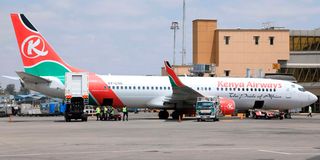
The State is expected to attach other assets to sweeten the deal for an airline that runs on negative equity, where its debts exceed assets.
“The new investor is expected to inject a minimum of $1.2 billion and up to $2 billion into the business. We shall be rolling out an international expression of interest to search for a strategic partner,” Mr Mbadi said, without giving the structure of the deal.
“The government took up Sh63.1 billion (from the novation of the Tsavo facility), which it is now servicing. The government then signed an on-lent agreement with KQ. This amount can be converted to equity once we firm up the onboarding of a strategic investor.”
The State had earlier mulled a turnaround deal at KQ tied to the targeted investor upgrading Jomo Kenyatta International Airport (JKIA).
Turning around the fortunes of KQ has been a major headache for the Treasury, which had promised the International Monetary Fund (IMF) to find a strategic investor to pump money into the national carrier.
The airline planned to announce a strategic investor last year to support capitalisation of the company and boost its efforts to reduce debt and expand operations.
Failure to turn around KQ is one of the unmet conditionalities in the programme Kenya had with the Washington-based IMF.
In 2017, the government and 11 top banks, including KCB, Equity, Cooperative Bank and NCBA, converted part of the billions owed to them into equity in an effort to return the carrier to profitability.
The swap deal, which cut debt and eased the pressure on cash flow, increased the government’s shares to 48.9 percent from 29.8 percent while banks got a 38.1 percent stake, through a special vehicle.
Air France KLM’s 26.7 percent stake was diluted to 7.8 percent.
Analysts reckon that the government might have to add a sweetener to the KQ deal by bundling the beleaguered carrier with another asset to entice investors.
The analysts also favour an equity over debt investor in the quest to ease the mounting loan pressures on the airline.
“The proposal is reasonable, but the challenge will be getting an investor to commit funds and realise a return on investment (ROI). The government can add something to go along with the deal such as offering KQ airport terminals to the investor,” said Eric Musau, the head of research at Standard Investment Bank (SIB).
“It will be important for the government to convert its debt in the company to equity to support the financial restructuring. The investor must also put in equity and not debt to avoid saddling KQ with even more liabilities. An equity investor will also help with the running of the company.”
The State earlier said it was considering a scenario where the investor tapped to upgrade and operate JKIA would have Kenya Airways as its “anchor tenant”, arguing it was modelling a deal on Dubai International Airport.
The Treasury was not clear on how this arrangement would operate, though in the case of Dubai, the major airline, Emirates Airlines and the airport are all owned by a sole investor: the government.
The two have a symbiotic relationship, with Emirates using the airport as its global hub and operating from Terminal 3, which is also the largest single terminal building in the world.
Emirates also enjoys lower landing costs compared to its competitors amid concerns of unfair competition.
Kenya abandoned a deal that could have seen India’s Adani Group upgrade JKIA under a public-private partnership model.
“We are looking for the least disruptive option with restructuring set to occur within the framework of current financial/lease, licenses agreements,” Mr Mbadi said.
“The onboarding of a strategic partner can bring not just financial resources but expertise and best practices in running a successful airline.”
News on the search for a strategic investor has been key in driving KQ shares at the Nairobi Securities Exchange (NSE).
KQ’s share price rose 42.7percent since the start of January to Sh5.04 a piece amid reports that a Middle Eastern airline was keen on a deal, giving the carrier a market value of Sh28.6 billion.
The carrier’s equity position worsened in the six months to June 2025 at negative Sh129.5 billion from negative Sh118.2 billion as the company slumped back to a half-year loss of Sh12.15 billion, compared to a profit of Sh634 million in the same period a year earlier.
KQ’s total liabilities stood at Sh309.9 billion at the end of June against assets of Sh180.3 billion.
The airline says it is seeking to raise at least $500 million (Sh64.5 billion) in extra capital to expand and improve its fleet. It attributed the loss to a drop in revenue and passenger numbers caused by three of its planes - Boeing 787-8 Dreamliners - being out of commission for maintenance.
The pre-tax profit that the airline posted in the first half of 2024 was the first it had made in over a decade.
KQ went into insolvency in 2018 after an expansion drive left it with debts reaching hundreds of millions of dollars.
It has relied on State financial support, with the government paying off a loan of Sh19.4 billion in January last year that the airline had received from local commercial banks.
The resumed search for a strategic investor comes after its CEO Allan Kilavuka and chairman Michael Joseph departed the firm in November and June respectively.