Kenya attracted a lower value of foreign and domestic investments in the last financial year even as jobs created by State-facilitated projects rose, signalling a shift towards labour-intensive ventures amid tighter global capital flows.
The value of government-facilitated investments fell by 10.26 percent to Sh106.68 billion in the year ended June 2025 from Sh118.88 billion a year earlier, according to figures from the State Department for Investment Promotion. This marked the first year-on-year decline in three years, following strong growth in the previous two.
Capital inflows also missed the government’s Sh120 billion target, underscoring the difficulty of mobilising large-ticket investments amid global uncertainty triggered by the US tariff wars.
The weaker performance coincided with a drop in the number of investment projects facilitated, which fell to 149 from 207 a year earlier, well below the 210-project target.
Officials attribute the slowdown largely to reduced global foreign direct investment (FDI) flows, which have intensified competition among emerging markets for a smaller pool of capital. In a budgetary report for the upcoming financial year starting in July, the department said the investment value and project targets were missed due to the decline in globally attracted FDI.
FDI inflows into Kenya—through greenfield projects or mergers and acquisitions—were largely flat in 2024, according to the latest UN Conference on Trade and Development (UNCTAD) World Investment Report.
The report estimates inflows at $1.503 billion (Sh193.86 billion), a marginal 0.07 per cent drop from $1.504 billion (Sh193.99 billion) in 2023.
This means annual foreign investment flows into Kenya declined for a second consecutive year, against a backdrop of increased taxation, reduced incentives and heightened uncertainty following deadly anti-government protests in mid-2024 and 2025.
Despite softer investment inflows, employment creation exceeded expectations. Projects facilitated during the review period generated 12,500 new jobs, up from 12,061 in 2023/24 and above the 12,000-job target.
This marked the second straight year that job creation beat projections, reflecting a rise in labour-intensive projects that require less capital but absorb more workers.
The State Department said the employment target was surpassed due to the registration of labour-intensive ventures.
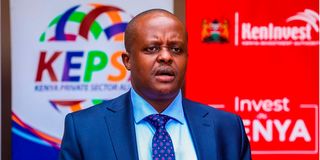
Kenya Investment Authority (KenInvest) chief executive John Mwendwa said the focus is now on targeted investment promotion to reverse the decline in deal volumes and improve project quality.
“We want to create a bankable pipeline of opportunities that we can begin to close,” Mr Mwendwa said in an interview last year.
He added that transforming KenInvest into a fully functional one-stop shop for investors and positioning it as the central repository of investment data are key priorities, alongside improving deal completion rates. The agency is targeting a 40 per cent conversion rate—closing two out of every five deals.
Businesses have long complained about overlapping regulatory requirements at national and county levels, which they say drive up operating costs. Companies typically need close to 20 permits and licences, depending on the nature of their operations.
These include approvals related to business registration, calibration, premises safety, environmental standards, food and beverage processing, waste management, water and sewerage, noise and vibration, construction regulations, cess payments, specialised materials, controlled substances and conservancy fees.
Mr Mwendwa said Kenya’s macroeconomic fundamentals and infrastructure investments continue to underpin its long-term investment appeal.
“At the macro level, things are working, and certain indicators are headed in the right direction,” he said.
However, an unpredictable tax regime remains a key concern for investors. KenInvest has convened a roundtable involving the Kenya Revenue Authority and the private sector to address the issue.
“There has been a pronouncement by the President that tax predictability should be on a three-year rolling basis rather than annual changes,” Mr Mwendwa said, adding that work is underway to assess how such a framework could be implemented.
“If you look at sub-Saharan Africa, excluding South Africa and Egypt, we are doing okay. But we could do better—and we want to do better.”