Time flies with great content! Renew in to keep enjoying all our premium content.
Prime
Kenya in 2-month dash to comply with EU coffee import regulations
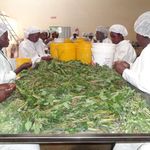
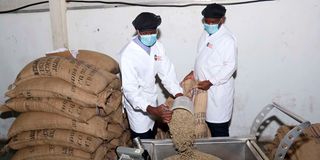
Employees at African Coffee Roasters in Athi River who process and package high quality branded coffee for local and export markets on September 16, 2021.
The government has set out to map 76,696 hectares of coffee farms across the country over the next two months as Kenya rushes to comply with a European Union (EU) market rule that seeks to ban the sale of goods linked to deforestation starting January next year.
The exercise, set to be completed by the end of September this year, will be coordinated by the Agriculture and Food Authority (AFA) and will also involve the State Departments of Agriculture and Cooperatives, the Kenya Forest Service (KFS), and the Kenya Space Agency (KSA).
Other institutions involved include the Directorate of Resource Surveys and Remote Sensing (DRSRS) and the Kenya Agricultural and Livestock Research Organisation (KALRO).
Already, AFA says the government has been able to geo-map approximately 30 percent of the national coffee-growing land in 16 out of 33 counties – representing 32,688 hectares of coffee farms out of the total national growing area of 109,384 hectares.
“In the next two months, several teams under the EUDR (European Union Deforestation Regulation) Data Committee will be mapping out the remaining coffee production areas countrywide. The exercise is expected to be completed in due time to meet the deadlines set in the EUDR,” said the AFA.
The EU Parliament voted in November last year to bring forward the implementation of the EUDR from 30 December 2024 to 30 December this year, in response to concerns raised by member states, non-EU countries, and traders that they would not be able to comply within the earlier set timelines.
Under the EU Deforestation Regulation, importers of commodities such as coffee, cocoa, soya, palm oil, cattle, timber, and rubber – and products that use them – must prove that their goods did not originate from deforested land or face hefty fines.
Failure to acquire a certificate of proof against deforestation could harm Kenyan producers, since seven of Kenya’s ten leading coffee markets are in the EU.
The rules will see the EU market only allow imports of seven agricultural products—coffee, cattle, cocoa, oil palm, rubber, soya, and wood products—whose sellers can prove the commodities were not grown on land deforested after 31 December 2020.
The postponement of the EUDR implementation by a year came as a major relief to local coffee exporters who risked losing access to the EU market – Kenya’s largest – due to low levels of compliance.
“Kenya exports 95 percent of its coffee, with approximately 55 percent going to the EU, mainly Belgium, Germany, Sweden, and Finland,” noted the AFA in its latest release.