Time flies with great content! Renew in to keep enjoying all our premium content.
Prime
KDF gets Sh6bn Israel loan for air defence amid Iran war
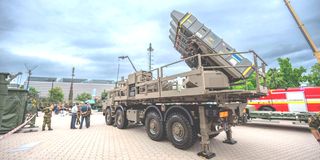
The Spyder, an Israeli mobile air defence system, similar to the one Kenya has secured a loan to acquire, as part of the country's military modernization programme.
Kenya has secured a Sh6.1 billion Israeli-backed loan to acquire a high-tech missile defence system, strengthening its ability to counter aerial threats amid rising regional insecurity and concerns that the Israel–US war against Iran could spill over into the Horn of Africa.
The funding for the financial year starting July 2026 marks a 79.4 percent increase from the Sh3.4 billion the Ministry of Defence is expected to receive from Tel Aviv in the current financial year ending June, according to a Treasury budget report.
Two years ago, the Treasury revealed that Kenya was seeking a Sh1 billion loan from Israel to buy a system dubbed the Spyder Defence System.
The Spyder – short for Surface-to-air PYthon and DERby – is a low-level surface-to-air missile system designed to counter attacks from aircraft, helicopters, unmanned aerial vehicles (drones) and precision-guided munitions.
Compared to the sophisticated long-range defence systems deployed against missile attacks in the ongoing Middle East conflict, Spyder is mainly designed for low-level threats such as drones.
Budget documents tabled in Parliament show that the Treasury expects the loan to be directly wired to the Ministry of Defence in the financial year starting this July.
Kenya is seeking to modernise its military amid rising regional and global security threats, including persistent attacks by Al-Shabaab and emerging risks tied to Iran-backed Houthi militants in Yemen, whose reported links with Somali-based networks have heightened concerns over cross-border insecurity.
The Houthis have proved to be one of the most disruptive and resilient members of Iran’s axis of resistance, which includes Hezbollah.
In total, the Ministry of Defence will spend Sh10.3 billion on its military modernisation programme between July this year and June 2027, up from Sh4.73 billion in the current fiscal year.
The government’s financing for the upgrade for the year starting July is Sh3.7 billion, a 4.6-fold increase from Sh800 million in the period between July last year and June 2026.
Spending on this modernisation programme is projected to rise by 61.5 percent to Sh16.63 billion in the financial year starting July 2027 before increasing further to Sh21.63 billion in the following fiscal year in what could spark an arms race in the region.
Capability gap
In the budget documents, the Ministry of Defence says rapid advances in military technology are making its equipment obsolete faster and raising the cost of upgrades.
It also cites challenges such as limited funding leading to pending bills, porous borders, staff shortages, rising disasters, land disputes, and the high cost of land acquisition and compensation.
“The ministry’s priorities during the MTEF period 2026/27–2028/29 will be capacity building and sustainability of manpower, continued modernisation of systems and equipment, enhancing force posture through infrastructure modernisation, enhanced maintenance of major systems, increased investment in research and development, implementation of strategic intervention projects, defence industrialisation and continued operations of civilian support,” the budget document says.
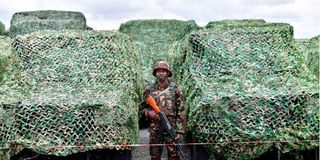
KDF military vehicles at the Embakasi Garrison in Nairobi on November 2, 2022.
Photo credit: File | AFP
Air defence
Kenya’s air defence is built around short-range systems, including older Rapier missiles and fighter jet interception, but it lacks the advanced long-range missile defence systems seen in major conflict zones.
Currently, Kenya mostly uses Rapier ground-to-air systems, an anti-aircraft missile system originally developed by the British Aircraft Corporation in the 1960s for the British Army and Royal Air Force.
The Rapier entered service in 1971 and was first used on the battlefield during the Falklands War. However, as attack weapons advance, countries have been phasing out this system while moving to more sophisticated ones such as Sky Sabre, Patriot and NASAMS.
A study by the United Nations Institute for Disarmament Research (UNIDIR) found that most non-state armed groups in Africa, including terrorists, have developed an interest in uncrewed aerial systems (UASs) such as drones, making it urgent for countries such as Kenya to upgrade defence systems.
Al-Shabaab is one of the groups that, although it has yet to use these systems for military attacks, is close to attaining such capabilities, according to the report.
“Concerns have been raised regarding Al-Shabaab’s ability and intent to weaponise UASs for attacks against civil aviation infrastructure,” the report, published in 2024, says.
Intelligence warning
The director-general of the National Intelligence Service, Noordin Haji, warned that Kenya is facing an even bigger terror threat, underscoring the need to speed up efforts to acquire modern defence systems.
“As part of this expansion, ISIS and Al-Shabaab have been collaborating with the Houthis, gaining access to advanced weaponry and sophisticated training. The spillover effects are now being felt in Africa, making the continent an emerging epicentre of terrorism,” Mr Haji said.
Kenya is seeking to further modernise its military capabilities in the face of civil wars in neighbouring countries, including Somalia, Sudan and Ethiopia.
It already has troops in Somalia, a factor that has made it a target for Al-Shabaab.
The acquisition of the Spyder Defence System will add to Kenya’s military spending.
Kenya spent Sh166.8 billion on military equipment last year, up from Sh147.37 billion in 2023.
The US and Turkey are the main suppliers of military gear to Kenya, including helicopters, armoured vehicles and drones.
The modernisation of the military is also intended to ensure that the Kenya Defence Forces meets the standards set by the United Nations to qualify for funding during peacekeeping missions.
Three years ago, the government disclosed that it would spend Sh7 billion annually to modernise security agencies over five years.