At least six multinational banks, consultancies and think-tanks have marginally downgraded Kenya’s economic growth outlook on the recent wave of violent anti-government protests.
Economists at Moody’s Analytics, Fitch Solutions, Standard Chartered Bank of London, Allianz of Germany, Fitch Ratings and Citigroup Global Markets, have trimmed growth projections by between 10 and 40 basis points, largely citing the impact of bloody social unrest on investment sentiment.
Overall, a consensus outlook from 14 firms, compiled by Barcelona-based FocusEconomics, indicates the economy will likely expand 4.9 percent compared with 5.0 percent a month ago.
“Overall in 2025, GDP growth is seen outpacing 2024’s — the slowest since the pandemic — likely coming in above the Sub-Saharan Africa regional average once again, thanks to stimulus from interest rate cuts,” analysts at FocuEconomics wrote in the August 2025 edition of the FocusEconomics Consensus Forecast - Sub-Saharan Africa.
“That said, rising instability from civil unrest — sparked by recent police brutality and high cost of living — has hit investor sentiment. Fiscal consolidation and adverse weather shocks also pose downside risks.”
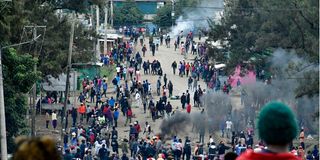
Protests to mark the first anniversary of the historic, deadly Finance Bill 2024 demonstrations on June 25 and Saba Saba Day protests on July 7, left more than 50 civilians dead and property worth millions of shillings either looted or destroyed.
State-run Kenya National Commission on Human Rights (KNCHR) put the death toll on June 25 at 16 civilians, while 38 others lost their lives on the Saba Saba Day — an annual pro-democracy march to mark the anniversary of the July 7, 1990 demonstrations, which led to a return to multi-party democracy.
Economists at Moody’s Analytics have cut Kenya’s growth outlook by 0.4 percentage points to 4.8 percent, while Fitch Solutions now sees the country's economy expanding by 5.2 percent compared with 5.5 percent a month ago.
Standard Chartered of London expects the country’s GDP— a measure of all economic activities by the government, companies and individuals — to grow by 4.5 percent compared with 4.7 percent forecast a month ago. The StanChart’s projection shows growth could be slower than 4.7 percent last year if it comes to pass.
Analysts at Citigroup Global Markets, Fitch Ratings and Allianz, have trimmed Kenya’s growth outlook by 0.1 percentage points compared with the prior month’s outlook to 5.5, 5.0, and 4.7 percent, respectively.
Kenyan youth have, since last year, taken to the streets to protest against poor governance, high taxation, lack of job opportunities and corruption in government.
The demonstrations, which were initially triggered by a tax bill in June 2024, which was later withdrawn, have persisted, with President William Ruto’s administration coming under fire over police brutality and unexplained disappearances of government critics, in the wake of anti-government protests.
“It is essential that legitimate grievances at the root of these protests are addressed,” United Nations High Commissioner for Human Rights Volker Türk wrote in a statement on July 8.
“Under international human rights law, intentional lethal force by law enforcement officers, including with firearms, should only be used when strictly necessary to protect life from an imminent threat. Those responsible must be held to account.”
The fresh wave of anti-government protests has threatened to dampen momentum in economic activity, which has been supported by a gradual but steady fall in the cost of loans to an average of 15.44 percent in May from a recent peak of 17.23 percent last November ,amid a relative stability in inflation and forex markets.
Businesses had frozen investment projects in 2024 due to the deterrent cost of borrowing amidst economic uncertainty that followed the deadly anti-government protests at the tail end of the second quarter and start of the third quarter.
Stung by last year’s countrywide social unrest, the Ruto administration has steered away from aggressive taxation measures this financial year ending June 2026, and has instead pledged to focus on improving tax administration and cutting down on expenditure.