Elevated energy prices, global tariffs dull CEOs’ Kenya outlook

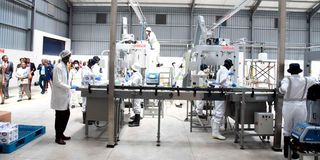
High Chem Industrial Park in Industrial Area, during the opening of new manufacturing units, with five lines of Reckitt products Jik and Harpic on November 29, 2022. 

Photo credit: File | Nation Media Group

Chief executive officers (CEOs) of corporations in Kenya worry about possible increases in input costs within the current quarter ending next month, fueled by the recent jump in energy prices and the impact of higher global tariffs, which they say have raised the prices of key raw materials.

In a new survey conducted by the Central Bank of Kenya (CBK), 64 percent of the sampled CEOs anticipate a negative impact of the recent US trade tariff increases and policy changes through higher import costs for inputs and finished goods.
“Concerns on price developments in the future remain, following the recent increase in energy prices and the impact of higher global tariffs, which have impacted the prices of raw materials,” the CBK said in a report.

President Donald Trump slapped wide-ranging trade tariffs on countries worldwide, including Kenya which was hit by a 10 percent charge on exports to the US market from August 1, 2025.

Over the past few months, signs of elevated factory prices have manifested.

For example, recent data by the Kenya National Bureau of Statistics showed that the Producer Price Index (PPI) – which tracks the movement of production costs – stood at 138.16 at the close of June 2025, up from 137.95 at a corresponding time last year.

This resulted in a 0.15 percent year-on-year producer inflation rate, reversing a full-year deflation trend that stood as low as -5.67 percent in March this year. A higher PPI translates to higher consumer prices as the manufacturers seek to recoup the additional cost incurred in production.

During the period under review (quarter to June 2025), electricity, gas, and steam supply costs rose 1.26 percent compared to a similar quarter last year, while manufacturing expenses grew by a marginal 0.31 percent.

Producer prices in the mining and quarrying sector, on the other hand, declined 7.55 percent, while water supply, sewerage, and waste management costs dropped 2.69 percent.

Kenya’s Consumer Price Index, which measures the actual change of retail prices, climbed to a three-month high of 4.1 percent last month, with key pressure coming from the prices of food and non-alcoholic beverages, transport, housing, and utilities.

The rate had remained unchanged at 3.8 percent for two months in May and June as costs of key household essentials, including electricity, cooking gas, and kerosene, dropped.

The Energy and Petroleum Regulatory Authority (Epra) last week announced a marginal Sh1 drop in the costs of a litre of petrol and that of diesel, a month after the prices recorded the highest jump in nearly two years, rising by Sh8.99 and Sh9.65 a litre, respectively.

A litre of petrol now retails at Sh185.31 in Nairobi, for the monthly pricing cycle to September 14,2025 while diesel, whose price remains unchanged, is selling at Sh171.58. Kerosene, on the other hand, sells at Sh155.58.

The CBK noted that demand orders, growth sales, and production volumes were slower in July compared to May when a similar survey was last conducted, reflective of muted consumer demand.

“Prices of goods and services bought (by firms) are expected to be lower, supported by low inflation, while prices of goods sold are impacted by muted demand and stiff competition, resulting in firms discounting their prices to retain customers,” the apex bank said.

The CEOs also expressed jitters about reduced export earnings to the US after the expiry of the African Growth and Opportunity Act (Agoa) – a law designed to facilitate trade and investment between the US and sub-Saharan Africa – on September 30 this year.

Kenya is a major beneficiary of the Agoa, which grants duty-free access to a wide range of its goods to the US market. Three-quarters of Kenya’s US-bound exports benefit from duty-free access to the US under Agoa.

More than half of Kenyan exports to the US are comprised of clothing, macadamia, coffee, titanium ores and concentrates, and black tea.

The Agoa treaty, initiated under the Bill Clinton administration in 2000 to integrate sub-Saharan Africa into global trade and wean it off foreign aid, was initially intended to last for 15 years before being extended for a further 10 years in June 2015.

PAYE Tax Calculator

Note: The results are not exact but very close to the actual.