Debt repayments and pensions eat up half of revenues

Treasury

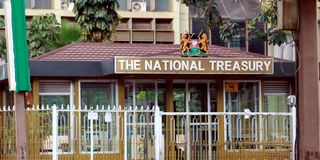
The National Treasury building in Nairobi. 

Photo credit: File I Nation Media Group

Spending on public debt repayments and pensions has for the first time gobbled up half of Kenya's domestic revenues in the year to June 2026, underlining the burden of loans and taking care of retired civil servants.

Spending from the Consolidated Fund Services (CFS)—the account for paying debt and pensions—accounted for 51.8 percent of taxes in the fiscal year to June, up from 49.8 percent a year earlier.
The two items accounted for 18 percent of tax revenues in the 2013/14 financial year, reflecting their impact in denying State resources for critical items like building infrastructure and stocking hospitals with drugs.

This emerged in a period when the Kenya Revenue Authority (KRA) has struggled to meet revenue targets amid rising expenditures, widening the deficit amid the mounting debts.

“The sharp increase in the CFS expenditures-to revenue ratio reflects rising debt servicing costs, revenue shortfalls, and growing financing needs,” the National Treasury said.

“By the financial year (FY) 2024/25 and FY 2025/26 period, nearly half of ordinary revenue was used for CFS expenditures, significantly reducing fiscal space for development and other priority spending.”

Pension payments covered 9.1 percent of ordinary revenues in the 2025/26 cycle, while interest costs were 42.7 percent.

The National Treasury spent Sh1.067 trillion on debt in the year, with Sh862.7 billion footing domestic interest while Sh205 billion covered payments on external debt.

The exchequer spent Sh995.1 billion a year earlier for debt service.

Interest costs on domestic debts have consistently been the largest part of loan repayment costs as the National Treasury increases reliance on the local credit market to plug the deficit.

The National Treasury borrowed a high Sh1.135 trillion domestically in the period to June 2026 to plug its Sh1.34 trillion deficit. Next external financing stood at Sh205.5 billion.

On pension, taxpayers spent Sh206.3 billion to keep retired civil servants comfortable in retirement, up from Sh15 billion in 2002, making it one of the budget items that has increased the most over the period.

For years, until 2021, public servants in Kenya did not contribute to their retirement upkeep and were paid straight from taxes.

Now, they contribute to their pension into a fund that invests, with the government’s role limited to the monthly contributions.

But it will take decades before the effects of the contributory scheme start reducing the pension bill in the CFS account.

Part of the pension time bomb has been attributed to the government’s failure to push through necessary reforms, including delays in launching the contributory pension scheme.

The exchequer has been forced to raise borrowing over the years to cover the rising fiscal deficit, which reached a GDP share of 7.1 percent in the 2025/26 financial year as revenues underperformed.

Kenya has had a fiscal deficit of at least five percent of GDP since the 2018/19 financial year.

The 2026/27 fiscal deficit is estimated at 5.5 percent of GDP, but is expected to fall to a low 3.1 percent of GDP in June 2030.

The National Treasury has, however, mostly deviated from its planned fiscal consolidation path, saddling Kenya with more debt. The rising fiscal deficit came amid revenue underperformance.

Tax revenues as a share of GDP have slacked in the same period covering the rise in debt service costs.

The share of ordinary revenue to GDP fell from a high of 18.1 percent in the 2013/14 fiscal cycle to a low 13.9 percent in the 2020/21 cycle, but has only recovered to 14.2 percent at present.

The proportion of ordinary revenue is expected to remain subdued at 14.7 percent in June 2028.

“Ordinary revenue has declined as a share of GDP despite rising in nominal terms, highlighting the need to strengthen domestic revenue mobilisation,” the National Treasury added.

“This is attributed to tax compliance gaps, an increase in tax expenditure, higher growth in low tax yielding sector-agriculture.”

Follow our WhatsApp channel for the latest business and markets updates.

PAYE Tax Calculator

Note: The results are not exact but very close to the actual.