Banks slashed interest on deposits to an average 25-month low of 8.37 percent in June, a reversal from the past two years when they had been raising returns to attract savers.
Analysis of data from the Central Bank of Kenya (CBK) reveals that the June rate declined from 8.7 percent in May, edging closer to the July 2023 average of 8.1 percent. The recent deposit rate marks the fifth time the figure has fallen below double digits.
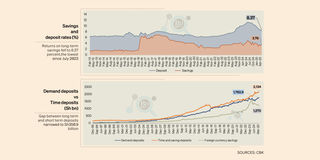
This is the fifth straight month in which deposit rates have fallen.
The peak was last recorded in June when the rates averaged a 26-year high of 11.48 percent, overtaken by the 12.99 percent seen in December 1998. Banks were raising deposits to lure savers from channeling deposits into government papers when returns were attractive.
The decline in deposit rates features at a time when the Central Bank Rate (CBR) has been revised downward, while returns on government papers, particularly the 91,182- and 364-day Treasury bills, are below 10 percent.
The falling deposit rates are a relief for the banks as they plan to revise the pricing of loans downwards following the CBR cuts.
The six top banks that have posted half-year results, paid customers Sh82.99 billion as interest on deposits in the six months ended June, marking a 9.1 percent drop from Sh90.56 billion in a similar period last year.
CBK cut its base rate in seven straight monetary policy committee meetings since August 2024, by a cumulative 3.5 percentage points to 9.5 percent.
The savings attracted lower interest compared to time deposits. CBK data indicates that commercial banks paid an average of 3.76 percent on demand deposits compared to 8.37 percent on term or fixed deposits.
Interest offered by lenders beat inflation that stood at 4.1 percent for 22 months, indicating lenders’ motives to lure cash-rich individuals.
The difference between the deposit rate and inflation is the real interest rate, which stood at 5.23 percent in April, posting a positive return in the past 25 months.
The returns on deposits arise when banks incentivise depositors to attract huge sums of money for onward lending as well as to government lending, as rates for state securities offer attractive rates.