For 400,000 Kenyans, the Middle East has emerged as a doorway to better employment opportunities and a source of livelihoods for their families back at home.
Nations such as Saudi Arabia, the United Arab Emirates (UAE), Qatar and Kuwait are the bedrock of these jobs in domestic work, transport, hospitality and security sectors.
But the widening conflict in the Middle East in the wake of joint US—Israel strikes against Iran has put these jobs at risk and billions of shillings in remittances and foreign exchange receipts at stake.
Iranian forces have launched a plan devised by Ayatollah Ali Khamenei and Tehran’s top commanders to sow chaos across the Middle East, create upheaval in global markets and raise the stakes in the hope of pressuring the US and Israel to halt their attack.
In the days since the US and Israel launched their war, Iranian drones have also struck hotels, airports and ports in countries including the UAE, Kuwait, Iraq, Oman and Bahrain.
Tehran has also escalated its response by targeting energy facilities in the oil-rich Gulf, firing drones at a critical gas facility in Qatar and one of Saudi Arabia’s biggest refineries.
The chaos is threatening jobs.
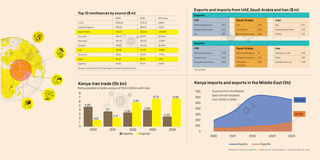
Over 310, 000 Kenyans are said to work in Saudi Arabia, 66, 000 in Qatar and nearly 30, 000 in the UAE. These workers wire billions of shillings to Kenya monthly for domestic consumption and investments.
Diaspora remittances sent from Saudi Arabia in 2025 were $302 million (Sh39.06 billion), followed by the UAE at $125.6 million (Sh16.24 billion) and Qatar at $69.7 million (Sh9.02 billion).
A prolonged war could threaten these billions of shillings.
Kenyan authorities have issued travel and security advisories urging citizens living in or passing through the Middle East, to exercise extreme caution amid unpredictable security developments.
Dubai, long perceived as a haven, now faces new security anxieties after Iranian attacks, demonstrated that even major Gulf commercial hubs are not immune to regional conflict.
The conflict has also put Kenya's trade worth over Sh700 billion at risk, with ramifications for inflation on costly fuel.
Surge in insurance costs, spike in cargo freight charges and costly energy, look set to trigger inflationary pressures on households struggling with diminished disposable incomes.
Kenya exports tea, coffee, meat and flowers as well as re-exported jet fuel to these countries at Sh165 billion in 2024, setting the stage for reduced earnings to farmers, freight carriers and oil marketers.
Shipments from these countries, like fuel, fertiliser, machinery and electronics worth Sh554 billion could be derailed.