Ruto seeks to bypass MPs on new power purchase deals

William Ruto

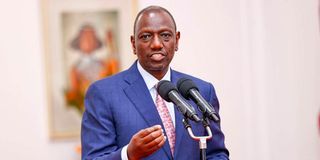
President William Ruto has accused lawmakers of “overstepping” their mandate by sustaining a freeze on new power purchase agreements.

Photo credit: Pool

President William Ruto has accused lawmakers of “overstepping” their mandate by sustaining a freeze on new power purchase agreements (PPAs), which has lasted more than two years, constraining expansion of the grid amid growing demand.

Members of Parliament put the brakes on negotiations of new power deals in April 2023 to allow for investigations into existing contracts between Independent Power Producers (IPPs) and Kenya Power, the near-monopoly state-run electricity distributor.
The moratorium on new PPAs came barely six months after the Cabinet had lifted the freeze imposed in line with recommendations of a presidential task force.

The President has said that the executive arm of the government is ready to bypass the freeze by the lawmakers and enter into new power deals.

“I have given clear policy directions to the Ministry of Energy. In spite of what Parliament has done, we have opened up that space for power purchase agreements and we are already negotiating with of the players in that section,” Dr Ruto told business leaders in Nairobi. 

“My directions to the Ministry are very clear because there are industries that cannot come [to Kenya] merely because they look at our grid, they possibly would need 1000MW, and they can’t find it.  Therefore, they go and look for other [investment] destinations” he added.

This came after the June 2025 deadline that had been announced by the Ministry of Energy for lifting the moratorium to allow Kenya Power to negotiate new power deals passed.

The executive arm of the government has, however, been pushing the lawmakers to lift the moratorium because dwindling spinning reserve on the grid could prompt power rationing if not urgently addressed.

"Hopefully, by the end of June, we are seeing a high possibility that Parliament will have lifted the moratorium. However, it might come earlier," Principal Secretary for Energy Alex Wachira said in May.

The President’s remarks also came more than three months after Vietnam Gas President Doanh Chau questioned the Ruto administration’s long-term commitment to industrialisation-led economic development.

Mr Chau wondered why Kenya was investing heavily in capital-intensive infrastructure at the expense of energy projects, which are a magnet for big-ticket multinational manufacturers with the potential to create millions of decent jobs for the growing, skilled unemployed youth population.

“Vietnam: 100 million people, over 70 GW of power. Kenya: 50 million people, only 4 GW. This is not a side issue; it’s the foundation of economic development. No investor will build a factory where the lights flicker every day,” the Vietnamese energy mogul posted after meeting Dr Ruto and Prime Cabinet Secretary Musalia Mudavadi to demonstrate how African leaders were big in talking but slow in execution.

“The government built a fancy expressway from Nairobi to Mombasa, without an export industry to support it. Meanwhile, millions live in slums and huts, with no access to reliable utilities.”

Kenya’s installed capacity was estimated at 3,199.9MW in June 2024, a capacity Dr Ruto has pledged to more than double by 2030.

Kenya Power has in the past warned that thinning extra capacity at a time when growing demand for power is not being matched by local generation could result in sustained rationing.

“Parliament has overstepped its mandate. Parliament should not be deciding matters to do with executive function. We certainly need another 5,000MW in our grid sooner rather than later. The 3500MW where we are now is constraining,” Dr Ruto said.

“We are reorganising that space. Just give me a bit of time, and we will have a clearer picture. By God’s grace, before 2030, we should have doubled the grid that we have. And we should try and do it with renewable energy. We are clear on how that is going.”

Lawmakers have for years been pushing for a review of the existing PPAs, which Kenya Power signed in the past with IPPs, and has in the past recommended the formation of an independent office to procure new IPPs under fresh terms.

IPPs, whose power sale agreements are typically for 20 years, have come under fire for costly deals with Kenya Power, which have kept electricity prices elevated and lowered Kenya’s competitiveness to investors.

An analysis in 2023, for example, showed that IPPs, which largely run diesel-powered generators, sold electricity for an average of Sh11.87 per kilowatt-hour (kWh or unit), more than double the State-run Kenya Electricity Generating Company’s (KenGen’s) Sh3.93 per unit.

The low reserves have increased the possibility of widespread rationing or countrywide blackouts, especially when demand peaks at night. This risk would be more pronounced if there is a major disruption on the line from Ethiopia.

The freeze on the new PPAs has exposed Kenya Power, forcing the utility to turn to Ethiopia for more power, especially during the peak demand at night. Kenya Power seeks to tap between 50 and 100MW more from Ethiopia to help avert power rationing when demand peaks.

PAYE Tax Calculator

Note: The results are not exact but very close to the actual.