EPZ firms shed 5,337 job openings amid Agoa uncertainty

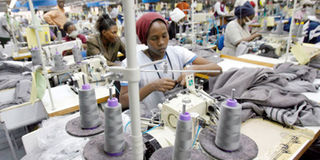
Workers at the Export Processing Zone in Athi River where companies operate under the tariff-free zone. 

Photo credit: File | Nation Media Group

Kenya lost more than 5,000 new job opportunities within its Export Processing Zones (EPZs) in the last financial year as uncertainty over duty-free access to the US market delayed factory expansion and contributed to company exits.

New job openings are potential career options and future possibilities, whereas actual jobs are concrete, active roles where people are hired and get paid.
The setback came as the US Congress on Tuesday passed a stop-gap funding bill extending the African Growth and Opportunity Act (Agoa) through the end of 2028.

New data published by the State Department for Investment Promotion shows enterprises in tax-friendly EPZs created 6,732 jobs in the year ended June, representing a drop of 5,337, or 44.2 percent, from 12,069 new opportunities created a year earlier.

“This was mainly attributed to delayed commencement and expansion of some EPZ enterprises; some exits and uncertainty on Agoa extension,” the State Department for Investment Promotion wrote in the medium-term spending plan report for 2027/28-2029/30.

The US House voted 370-48 to approve legislation extending Agoa through December 2028, following Senate approval of the measure on August 8.

House Ways and Means Committee chairman Jason Smith said the Agoa pact was important to US economic and national security interests, particularly in securing African critical minerals and reducing reliance on China.

“Agoa promotes greater economic stability and opportunity across Africa while advancing America’s strategic and national security interests,” Mr Smith said during the House debate.

He said stronger trade ties with Africa would help the US secure critical minerals and more resilient supply chains, arguing that Washington could not allow China to dominate the continent’s mineral resources.

The extension offers greater relief after months of uncertainty, but may not mean a return to the previous trade arrangement, with President Donald Trump's administration pushing for changes to make Agoa more beneficial to American businesses.

US Trade Representative Jamieson Greer said in April that a modernised Agoa should deepen economic ties with Africa while benefiting American workers, removing trade barriers and creating opportunities for US companies.

“We welcome comments from interested partners to help improve the programme, ensuring more reciprocal trade with our sub-Saharan African partners to strengthen America’s global competitiveness,” Mr Greer wrote in a public notice seeking views on modernisation of Agoa.

The comments point to a possible shift from Agoa’s traditional model of preferential access for African exports, with Washington seeking greater and reciprocal access for American goods in return.

This could introduce fresh bilateral negotiations between Washington and Nairobi even as exporters welcome the two-year extension of Agoa and seek to rebuild investor confidence.

The latest jobs data captures the cost of uncertainty that followed AGOA’s expiry on September 30, 2025, when Kenyan exports temporarily lost preferential access to the US market.

Between October 2025 and January this year, the Kenya Association of Manufacturers said exports to the United States faced tariffs ranging from 15 to 42 percent.

The duties included a 10 percent reciprocal tariff imposed on Kenyan exports from August 2025, adding pressure on largely apparel manufacturers whose businesses and production plans have been built around preferential access to the American market.

AGOA was reinstated in February, but only through December 2026, leaving businesses with limited certainty over market access beyond the end of this year.

That uncertainty affected longer-term decisions on opening factories, expanding production lines, buying equipment and hiring workers, the Investment Promotion department says, reversing hiring in EPZs after a strong rebound the previous year.

In the financial year ended June 2025, EPZ enterprises largely in Athi River and Thika created 12,069 jobs, beating the government’s target of 8,000 by 4,069 opportunities.

The government subsequently raised its target to 12,000 jobs in 2025/26, but actual hiring fell short of this target by more than 5,000 opportunities, highlighting the volatility of employment growth in Kenya’s export manufacturing sector.

Kenya has relied on Agoa since 2000 to export apparel, tea, coffee, macadamia nuts, fresh produce and other products to the US under preferential terms.

The programme has been particularly important to apparel manufacturers, allowing Kenyan factories to compete for American orders, while supporting tens of thousands of formal jobs.

The House approval, through stop-gap funding legislation to keep the federal government open beyond the end of the fiscal year on 30 September, now awaits Mr Trump’s assent.

PAYE Tax Calculator

Note: The results are not exact but very close to the actual.