Kenya’s EV charging stations project to cost Sh6bn

basigo

An electric vehicle is plugged into a charging station in TJ&U garage in Nairobi, Kenya on May 24, 2023. 

Photo credit: File | Nation Media Group

Kenya needs $47.26 million (Sh6.12 billion) to install 10,000 electric vehicle (EV) charging stations, highlighting the substantial costs the country faces in scaling up clean-powered transport.

A policy document from the Ministry of Energy and Petroleum shows that the project will be implemented in three phases, beginning with 17 towns along the country’s major highways from Mombasa to Busia, at a cost of $9.16 million (Sh1.18 billion).
The second phase will target an additional 23 towns and roads linking to the major highways earmarked in the first phase, at an estimated cost of $13.9 million (Sh1.8 billion). The third and final phase will cover all satellite towns and county headquarters not included in the first two stages.

This final phase is expected to be the most expensive, costing an estimated $24.2 million (Sh3.13 billion).

The document, titled the National Energy Compact 2025-2030 and which was submitted to the African Development Bank (AfDB), shows that the project will be fully funded via public funds.

The AfDB is one of the biggest financiers of Kenya’s energy generation and transmission projects, which run into billions of shillings.

The lack of charging stations outside Nairobi is one of the biggest hurdles hampering the uptake of EVs. As of December last year, Kenya had 5,294 EVs, which is a 41 percent increase from the 3,753 recorded in December 2023.

The disclosures on the phased establishment of charging stations come two years after the energy regulator gazetted regulations requiring the construction of the facilities every 25 kilometres along the country’s major highways.

Kenya is keen to encourage the use of EVs and vehicles that are powered by liquefied petroleum gas (LPG) as part of the global efforts to reduce carbon emissions caused by the use of diesel and petrol.

The government has set an ambitious target to have EVs form at least five percent of all newly registered vehicles by 2030.

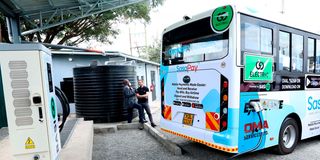
EVs on Kenyan roads range from buses and minibuses in the public transport sector to cars and motorcycles.

Other towns where the charging stations will be set up in phase one include Voi, Emali, Naivasha, Nakuru, Eldoret and Kisumu. Some of the key towns included in phase two are Malindi, Machakos, Narok, Kisii, Garissa and Nanyuki.

Users of EVs have cited lack of charging infrastructure outside Nairobi as the biggest concern, highlighting why the Sh6.12 billion expansion of the charging stations is critical.

The government also cut excise duty on EVs from 20 percent to 10 percent and also exempted EVs from value added tax (VAT). This is in addition to an EV tariff where a kilowatt-hour of power costs Sh8 and Sh16 at off-peak and peak times respectively.

Increased use of EVs is also part of efforts to grow electricity sales for Kenya Power and ultimately drive the firm’s profits.

Electricity consumption by EVs between July and December last year was 1.80 gigawatt-hours (GWh), a jump of 480.6 percent from the same period in 2023, underscoring the impact of the increased EVs.

PAYE Tax Calculator

Note: The results are not exact but very close to the actual.