India and Belgium have now emerged as key alternative source hubs for Gulf oil majors as they race to sustain supplies of petroleum products to Kenya amid transportation disruptions on key traditional routes related to the raging US-Israel war with Iran.
Kenya has a deal with Saudi Aramco, Abu Dhabi National Oil Company, and Emirates National Oil Company to supply petroleum products under a government-to-government (G-2-G) contract since March 2023.
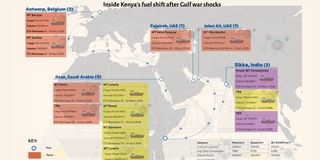
The products have for close to two years been mainly loaded from ports in the Arabian Gulf, but the US-Israel war with Iran has forced a change in the logistics pattern to avoid attacks on vessels on the Strait of Hormuz, the vital maritime chokepoint that connects Gulf waters and the wider Indian Ocean beyond.
Official documents show that petroleum products destined for Kenya would be mainly lifted from Antwerp-Bruges in Belgium, Sikka in India, and Jizan on the coast of the Red Sea—marking a shift from the past, where Kenya mainly relied on fuel loaded at ports in the Arabian Gulf.
The documents seen by the Business Daily show that 239.1 million litres of petrol will be loaded onto two vessels at the port of Antwerp-Bruges in Belgium. The ships will sail via the Red Sea-Mediterranean route and are expected at the port of Mombasa between April 16-27, 2026.
A further 156.75 million litres of fuel is expected to be loaded at Sikka port in India next month. The cargo has 81.15 million litres of dual-purpose kerosene and 75.6 million litres of diesel. These vessels are expected at the port of Mombasa between April 12 and 21,2026.
Another one, MT Constantinos, that discharged 82.38 million litres of dual-purpose kerosene in Mombasa on March 19, was loaded at Sikka port in India.
A further two vessels, loaded at the port of Jizan in the Red Sea, discharged in Mombasa between March 18 and 20.
An itinerary showed that the cargo vessels will sail the Mediterranean-Red Sea route to the Mombasa port.
“Before the conflict, loading fuel mainly happened in ports within the Arabian Gulf, but now the loading is mostly happening outside, in Europe, India, and the Red Sea. These ports outside the Arabian Gulf are safe,” a top executive at one of the oil companies said.
“The long-term contracts secured under the G-to-G have come in handy; we are guaranteed fuel, and also our premiums are fixed, unlike in the spot market where rates have shot through the roof.”
Kenya and the Gulf states could, however, face anxiety as Iranian officials warned they could open a new battle front in the Red Sea and create "insecurity" in the Bab al-Mandeb Strait, which lies between Yemen and Djibouti, if US troops land on the Iranian island of Kharg. This could rattle the plans of delivering petroleum products through the Red Sea route.
Records show that Kenya had 159.89 million litres of diesel, 109.34 million litres of petrol, and 145.15 million litres as of Wednesday this week. These are enough to cover 16 days for diesel, 14 days for petrol, and 47 days for dual-purpose.
The documents show two vessels dubbed MT Lunaria, which were loaded at the Port of Jizan in the Red Sea, discharged a combined 120 million litres of diesel at the Port of Mombasa between March 18 and 20.
Additional stocks aboard the ships expected at the port of Mombasa will provide 22 days cover for diesel, a week’s cover for petrol, and 26 days for dual-purpose kerosene.
Petrol produced in the Gulf region is mainly refined in European refineries to meet the higher fuel specifications for the region. Saudi Aramco is now shipping part of this petrol to Kenya under the G-to-G deal.
The two ships that discharged diesel mid this month carried diesel supplied by Saudi Aramco, while the one that discharged dual-purpose kerosene was from Adnoc.
Adnoc is scheduled to load 81.15 million litres of dual-purpose kerosene at Sikka port, with the vessel expected at the port of Mombasa between April 19 and 21.
A total of 12 vessels have either delivered fuel or are expected to arrive at the Port of Mombasa between March 18 and April 27. The documents show that only one ship destined for Kenya, which was loaded at the Jebel Ali port in the United Arab Emirates, has been affected by the closure of the Strait of Hormuz. The ship is carrying fuel supplied by Enoc and was expected at the Mombasa port on March 30 at the earliest.
Energy and Petroleum Cabinet Secretary Opiyo Wandayi on Wednesday reiterated that fuel supply from the Gulf oil majors will continue as per the schedule, adding that the country does not run the risk of fuel outages in the coming weeks.
“The supply chain is intact, stocks are adequate, and we maintain full oversight of the national petroleum position,” Mr Wandayi said.
“For the April fuel cycle, supply replenishment is fully on track. Petrol vessels are confirmed to deliver a combined 330 million litres."
The move by Saudi Aramco, Enoc and Adnoc to turn to ports in India, the Red Sea, and Europe to load the fuel destined for Kenya comes at a time when a number of countries have been forced to ration fuel due to choked supplies.
Slovenia on Monday became the first European country to start rationing fuel, with private motorists restricted to a daily purchase of 50 litres while businesses have been capped at 200 litres.
Sri Lanka and Bangladesh were the first countries to implement fuel rationing early this month in a bid to conserve the fast-depleting stocks as supplies from the Gulf region remain disrupted.
Shell, one of the leading oil companies in the world, has also warned that Europe could be plunged into a fuel shortage if the Strait of Hormuz is not reopened.
Nearly 25 percent of the oil and liquefied natural gas for use globally passes through the Strait of Hormuz, underscoring the critical role of the canal in supplying the critical commodity across the world.
But Iran has since last month attacked 18 merchant ships along the route. The attacks, made using projectiles, missiles, drone boats and sea mines, are in retaliation for the US-Israel attacks.