How unfulfilled CBAs fuel strikes, cripple healthcare services

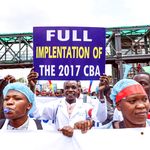
Medics take to the streets in Nairobi on April 16, 2024. 

Photo credit: File | Evans Habil | Nation Media Group

Kenya’s healthcare system has been gripped by a wave of strikes, repeatedly disrupting medical services and placing patients’ lives at risk.

Since 2010, the country has experienced seven nationwide public healthcare worker strikes. But in 2025, the crisis deepened as industrial action spread across both public and private hospitals, triggering one of the most turbulent periods in Kenya’s health sector in recent history.
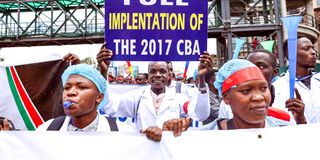
At the heart of the unrest are years of frustration over poor pay, delayed salaries, staff shortages, and deteriorating working conditions.

According to Kenya Medical Practitioners, Pharmacists and Dentists Union (KMPDU) deputy secretary-general Dennis Miskellah, the sector is operating under a Sh50 billion financing gap.

“There is also a severe shortfall in the human resources as counties are not employing and promoting medics as required,” he said.

The strike wave began early in 2025 when clinical officers walked out on February 17 before returning to work in March. Soon after, Kiambu County was plunged into crisis when doctors launched a historic 150-day strike on May 26,2025.

Nurses threatened a nationwide strike involving more than 8,500 Universal Health Coverage (UHC) workers, while additional stoppages erupted in Nyamira, Marsabit, Meru, Taita Taveta, and Siaya.

By September, seven healthcare unions were threatening a nationwide shutdown as Nairobi County health workers staged a month-long go-slow.

“We are prepared to take decisive action if our irreducible minimums are not conclusively addressed. The health and dignity of workers, and by extension, the nation, cannot be compromised any longer,” the health sector caucus said.

As services collapsed across counties, patients were forced to travel long distances in search of care, overwhelming the few hospitals that remained functional. Kenyatta National Hospital (KNH) became a last resort for thousands.

“Our staff are working tirelessly around the clock, but resources are stretched to the limit,” said KNH chief executive Dr Richard Lesiyampe.

With about 80 percent of Kenyans lacking health insurance, most families could not afford private hospitals when public facilities shut down, leading to deaths.

In Kiambu alone, Health Cabinet Secretary Aden Duale claimed that 164 newborns and 14 mothers died during the five-month doctors’ strike.

“Before the strike, Kiambu was doing well. But I want to confirm to the nation that several maternal deaths occurred,” he said.
The Kiambu strike eventually ended on October 24, 2025, after 18 mediation meetings.

Underlying the unrest is a web of unresolved Collective Bargaining Agreements (CBAs) between the government and health worker unions.

Doctors signed a CBA with county governments in 2017, updated in 2024, pushing intern pay to Sh68,165 and top consultants to Sh1.4 million. In September 2025, the government released Sh3.5 billion to clear doctors’ salary arrears dating back to 2017.

Nurses secured their CBA in August 2024, lifting the lowest basic salary from Sh16,692 to Sh23,369 and the highest to Sh181,160, plus allowances exceeding Sh50,000.

Clinical officers, however, remain stuck in limbo. Their CBA was finalised and approved by the Salaries and Remuneration Commission (SRC) in August 2025, but has never been fully signed.

Following a 99-day strike in 2024, the Labour Court ordered that it be concluded by October 2024—a deadline that passed without action.
On December 3, 2025, the Kenya Union of Clinical Officers (KUCO) issued a 21-day strike notice. When talks collapsed, clinical officers nationwide walked out at midnight on December 22.

On January 7, 2026, CS Duale told clinical officers to negotiate a new, inclusive CBA, arguing that the current document only covers about 150 officers employed directly by the Ministry of Health, out of roughly 33,000 nationwide.

“The document I have, which I can even sign tomorrow, is for only 150 clinicians,” he said, also accusing union leaders of being populist.
Clinical officers rejected his position, saying SRC had already approved the CBA and counties were responsible for signing agreements for their own staff.

PAYE Tax Calculator

Note: The results are not exact but very close to the actual.