Locals carve niche tourist site in Kilifi forest

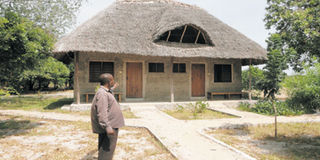
Francis Charo, the Arabuko villa manager, explains the features of a Giriama house at the site. The community has built a tourist attraction through combining conservation with favourable legislation.
Daniel Sitole

Kilifi residents are turning the world-famous Arabuko Sokoke Forest biodiversity into a business entity through combining conservation with favourable forestry laws to establish a niche tourist attraction.

Arabuko Sokoke Forest Adjacent Dwellers Association (ASFADA) comprises 152,000 members from 52 villages, working closely with the Kenya Forest Sevice (KFS) and KWS.

The Forest Act allows communities, in collaboration with the KFS) and KWS and other stakeholders to manage forests under the Participatory Forest Management (PFM).

Registered in December 2006, the association has established the Arabuko Jamii Villa, a seven-bed guesthouse situated in the forest, 800 metres off the Mombasa-Malindi road, and about 20km from Malindi town. It is made up of five houses — four built in a Giriama’s homestead style, and the fifth under the Swahili tradition.

The place is ideal for retreat seekers, researchers, scientists, and bird watchers. Besides offering full board accomodation for visitors, the facility also offers outdoor activities. These include canoe rides, walks in the nature trail, guided night tours in the forest and a creek tour.

“The PFM concept used in the country started at Arabuko Sokoke,” Athumani Mamu, ASFADA chairman, who is also the vice-chairman, National Alliance of Community Forest Associations, told Business Daily, “Before the PFM policy was introduced, communities were not allowed to make any beneficial use of the forests near them.”

The community has formed several groups which carry out income-generating projects in the forest. The projects include butterfly farming (Kipepeo Project), which exports live butterflies and larvae to Europe and other parts of the world. Other groups practise bee-keeping, growing medicinal herbs and agro-forestry.

A single bed is charged between Sh800 and Sh2,300, Sh1,200 and Sh4,000 for double, while a full house fetches between Sh2,400 and Sh7,600. Since the villa opened in October 2009, it has attracted an average of 30 bed-nights per month, except in March when the number rose to 60.

Arabuko Sokoke is the remnant of the largest block of coastal indigenous dry forest, which originally stretched from southern Somalia to northern Mozambique. The forest, which covers an area of 420 square kilometres on 41,765 hectares of land, is located in Malindi, 110km north of Mombasa. It borders the Indian Ocean.

Arabuko is famous for its biodiversity, which include endangered flora and fauna. It ranks second in bird conservation, after the Congo rain forest, and is home to 230 bird species of which six, locally known as the “Arabuko six”, are globally endangered.

These are Amani Sunbird, Clarke’s Weaver, East Coast Akalat, Sokoke Pipit and Spotted Ground Thrush.

Fifty-two mammal species have been recorded in the forest. They include three taxa, also under threat. 90 per cent of the world’s population of Golden rumpled shrew live in Arabuko Sokoke. The forest is also home to 150 elephants, 250 butterfly species four of which are endemic to Arabuko and 600 tree species, 50 of which are considered globally rare. Adjacent to Arabuko is a mangrove forest. The forest was first declared a Crown land in 1934, and gazetted Crown forest reserve in 1943.

The Community Development Trust Fund (CDTF), a project of the European Union and Kenyan Government, “funded the setting up of the villa to the tune of Sh4 million, while the community contributed about Sh2 million,” Francis Charo, the villa manager said.

However, lack of power supply is a major setback to the villa. It uses a generator for lighting between 7pm and 11pm, and thereafter visitors are provided with lanterns.

“The Kenya Power sent us a quotation of Sh1.8 million to install electricity for us, but we cannot afford it,” Mr Charo said. The villa also lacks regular supply of water.

The villa has the potential to create jobs for the local youth if fully operational. The people of Kilifi practice small-scale subsistence farming of maize, cassava and beans. Coconuts and cashewnuts are some of the cash crops in the area.

Malindi bears historical significance to Kenya, as it’s where Vasco Da Gama, the Portuguese explorer first landed on his way to India in 1498; Arabs settled here as early as 12th century, the first Christian missionaries came to the East Africa through Malindi.

However, the level of poverty for the local people is unbearable. According to government figures released in December 2011 by the Commission of Revenue Allocation (CRA), 71.4 per cent of the people in Kilifi live below the poverty line (less than $1 per day).

“It is true that our people are poor, Kilifi County is a symbol of poverty on an island of millionaires,” says Mr Charo, who is also a member of Gede Community Forest Association (GCFA).

In the absence of support from the Kenya Tourism Board, the villa’s management is hoping to raise Sh15 million to establish an elephant sanctuary and expand its nature trails, construct a conference hall, bar and restaurant, staff quarters, drill a borehole, and install electricity.

“The people of Kilifi are role models in conservation,” Blessingtone Maghanga, a senior forester at Kenya Forest Service (KFS), told the Business Daily. “We have no logging, charcoal burning, illegal fuel wood collection, mining or poaching in this forest.”

He adds that Somalia, Tanzania and Mozambique have destroyed parts of their share of the forest due to human settlement, “Our forest is as intact as it was more than a century ago.”

PAYE Tax Calculator

Note: The results are not exact but very close to the actual.