About a decade ago, Jannifer Muthike knew exactly what she wanted to do with her life: join the Air Force. Working in the uniformed service, jet engines, and high-altitude missions seemed like her destiny.
Then in 2012, her dreams were shattered when she was admitted to Moi University. Not for aeronautical engineering. Not even aviation. Instead, she was enrolled in a course in entomology and parasitology.
“I had no idea what that even meant,” she says. “I just remember thinking, how did I go from fighter jets to parasites?”
Entomology and parasitology are the scientific study of insects and parasites, not exactly the cockpit she had dreamed of, but a field that would soon change her life.
“Initially, I didn't want it. I tried switching courses and even universities, but nothing worked. So, I accepted my fate. One day at the university library, I stumbled upon the term 'black soldier fly' (BSF). That caught my attention —it reminded me of the dream to join the Air Force,” Jannifer recalls.
After graduating in 2017, she was mentored by an agripreneur who introduced her to large-scale insect farming.
But her journey to becoming a successful insect farmer began in October 2018, when she enrolled at the International Centre of Insect Physiology and Ecology to study insect farming. She then set up her first unit at her grandmother's house.
“I built a one-room setup using simple household basins. I ran it for a year. Interest started growing — people came for training, and eventually, I began consulting for organisations in Kenya, Rwanda and, most recently, Uganda, where I helped set up a unit producing one tonne of worm protein and five tonnes of fertiliser daily,” she says.
In 2020, she started her insect firm, Dudumasters. Located in Kirinyaga County, about 127 kilometres from Nairobi, the firm is not just minting money, but also driving sustainability.
The 29-year-old has built her success from a 30 by 30 square foot space in Kutus town that hosts 35 rearing beds.
“Our systems accommodate different species. For instance, red worms require deeper beds than black soldier fly larvae. Red worms prefer to be in the middle of the compost and struggle with heavy waste piles, unlike BSF, which thrive in such conditions,” says Jannifer.
Investment and income
With an initial Sh700,000 investment she now produces at least five tonnes of vermicompost weekly, selling it at Sh50 per kilo and generating around Sh250,000. She transforms what others throw away into black gold.
Vermicompost is produced by using various species of worms to decompose vegetable or food waste and bedding materials. The compost is rich in microbes that restore soil health and can increase crop yield by up to 44 percent. The food grown using this compost also tastes better as it retains its original flavour.
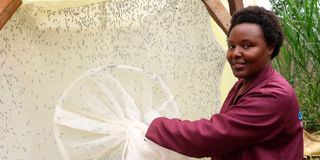
Jannifer says BSF are incredibly useful insects for waste management through out the four stage of their lifecycle: egg, larva (worm), cocoon (pupa), and adult. Under optimum conditions, she says, this cycle takes around 45 days —longer if it’s cold.
“Cold weather makes the flies less active,” explains Jannifer. “In warm conditions, they fly, mate and lay eggs much faster.”
So what does a typical day at the fly farm look like?
“It’s quite interesting. First, we collect waste —primarily animal manure and vegetable waste from farms. We also collect market waste from Kutus Market. But not just any waste —we’ve trained farmers on how to preserve waste that is suitable for us,” she explains.
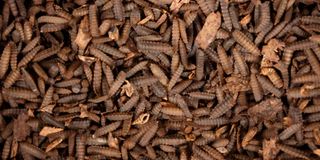
Dried black soldier fly larvae (Hermetia illucens) at Dudumasters in Kutus, Kirinyaga County on July 23,2025.
Photo credit: Evans Habil | Nation Media Group
“Once the waste arrives, we introduce it to the rearing beds. Depending on the plan, either red worms or black soldier fly eggs are added. For red worms, we allow them about two months to feed before harvesting. After 21 days, the waste turns into nutrient-rich compost. Once they are mature, we harvest the maggots, dry them using a solar dryer and sell as high-protein animal feed. The residue left behind —the frass —becomes vermicompost, which is used as an organic fertiliser,” she says.
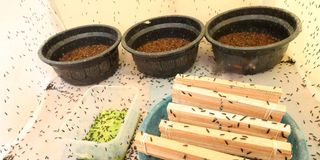
Jannifer explains that this is a continuous cycle. “As they die, they’ve already laid eggs for the next generation. With black soldier flies, we collect the eggs, incubate them, hatch the tiny worms and introduce them to waste. After 15 to 20 days, we sieve to get the cocoons. The cycle continues.”
She sells the fertiliser in 50kg bags for Sh2,500. Interestingly, unlike synthetic fertiliser, this compost never expires —it improves with age. Its microbial content continues to enrich the soil long after production.
“We also sell eggs to farmers looking to set up small units at home. A 10-gramme pack sells for Sh2,500. This may sound minimal, but harvesting eggs is an intensive process involving a great deal of labour and care,” she says.
A starter kit for small-scale farming costs around Sh35,000. This includes a cage and stand pre-populated with insects. With this setup, a farmer can produce 10kg of insect protein and 35kg of organic fertiliser each week.
On her agripreneurship journey, Jannifer has learnt many lessons. “Entrepreneurship demands resilience. It’s not for the faint-hearted. Sustainability sounds great on paper, but its implementation requires substantial support. Insect farming isn’t 'just waste and worm'. It requires serious technical knowledge,” she says.
“Our biggest challenge? Clients, particularly when it comes to vermicompost. There’s limited awareness of, and a lot of scepticism surrounding, insect-based products. Many still consider them to be unconventional. Another issue is that the chemical fertiliser industry is heavily subsidised, bringing prices down to Sh2,500 when the actual cost exceeds Sh5,000.”
Black soldier fly (BSF) breeding setup at Dudumasters in Kutus, Kirinyaga County on July 23,2025.
Photo credit: Evans Habil | Nation Media Group
“Meanwhile, organic fertiliser producers like us receive no subsidies, despite offering long-term solutions. We’re lobbying through the Organic Fertiliser Manufacturers Association of Kenya to have our products recognised and supported,” she says.
For those interested in starting a similar venture, Jannifer’s advice is clear: start small, but start smart. 'You don't need acres of land or millions to get started,' she says. 'But you must be consistent, clean and patient.' The biggest mistake is thinking it’s passive income.
These are living organisms — they need care, the right temperature, moisture and sanitation.'
She also emphasises the need to understand the market — not just for the maggots, but also for the compost. “It’s easy to produce, but harder to sell if you haven’t built trust and value.’ Branding matters. Training matters. Packaging matters.”
Return on investments
Return on investment is typically within three to six months.
“We’re not just selling products,” she says. “We’re creating a circular system where everyone benefits.”
What makes Muthike’s model so effective is that it fits perfectly into Kenya’s agricultural and waste management landscape.
The country produces over 5,000 tonnes of organic waste daily, much of which ends up in landfills, rivers and illegal dumpsites. Black soldier flies offer a natural solution by converting that waste into value.
“We want to scale up,” she says. “Our goal is to have 100 satellite units across the country, run by the community, fed by waste, and led by young people.”
Currently, her local setup employs two people permanently and many more on a contract basis when there is a lot of work. She aims to expand and create more employment opportunities.
“Looking back, I’m glad I didn’t join the Air Force,” she says. “This is greener, more grounded and a lot more profitable.”