Time flies with great content! Renew in to keep enjoying all our premium content.
Prime
Stanbic mulls startup entry in Addis to beat ownership limit
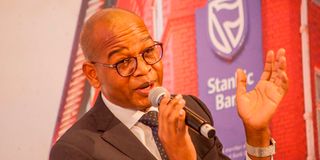
Chief Executive Officer of Stanbic Bank Kenya and South Sudan Joshua Oigara speaks during the lenders 2023 full year financial results briefing held on 6th March 2024 at Serena Hotel in Nairobi.
Stanbic Bank says it is ready and able to make a start-up operation in Ethiopia as it explores ways of circumventing a rule that caps foreign ownership at 49 percent when a lender enters that market through an acquisition.
This makes Stanbic Bank the first major African bank to consider the possibility of venturing into the Horn of African market without going through the acquisition route, which has been touted by many interested banks as optimal.
Stanbic, a subsidiary of Standard Bank – the continent’s largest bank by asset base – says gaining entry into Ethiopia by building from the ground is a card on the table, given its vast experience across 20 African countries, including Kenya.
In March last year, Ethiopia’s Central Bank – the National Bank of Ethiopia – issued Business Proclamation 136 ushering in the liberalisation of the country’s banking sector through allowing foreign institutional and foreign national investments into Ethiopia.
The liberalisation, however, comes with a rule that requires local investors to retain a minimum controlling interest of 51 percent, leaving the foreign buyer with a maximum minority stake.
“We generally go to new markets as a large and significant owner, and so a minority position is always going to be a difficult point to start with," Stanbic Bank Regional Chief Executive Joshua Oigara told the Business Daily in Johannesburg on the sidelines of President William Ruto’s state visit.
"It is also important to note that Ethiopia does not stop financial institutions from setting up from scratch if you want to own 100 percent of the entity. We have seen Kenyan enterprises setting up green field Ethiopia and we are confident."
Whereas many banks, including KCB Group and Equity Group, have signalled intent to venture into the Ethiopian market, the prospect of being a minority shareholder has been widely cited as a matter most find to be challenging.
Stanbic Bank says Safaricom Plc’s experience in entering Ethiopia through greenfield operations is a testament that whereas this route may be fraught with challenges, it is likely to yield dividends when perceived through a long-term horizon.
“One of our greatest clients is the telco business that went into Ethiopia a few years ago. It was an absolutely difficult environment, I agree. Does it tick the right boxes now? May be not yet. Are we seeing progress so far? Absolutely," Mr Oigara said.
"Sometimes we take a short-term view and look at things from a one-year, two-year or three-year lens, yet when you look at things from a 10-year perspective, you are likely to end up wishing you had even done more investment.”
In the just concluded financial year, Safaricom Ethiopia trimmed its loss position to Sh21.2 billion compared to a loss of Sh36 billion reported in the previous year, with the subsidiary’s service revenue having grown 58.3 percent to Sh14.1 billion.
Standard Bank has had a representative office in Ethiopia since 2015 and will be looking to build on this with the market entry that is under consideration.