Time flies with great content! Renew in to keep enjoying all our premium content.
Prime
Kuscco liquidation vote costs saccos Sh11bn
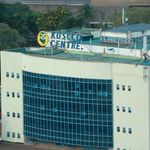
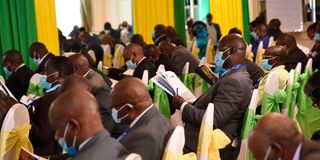
Delegates attending a past Kenya Union of Savings and Credit Co-operatives (Kuscco) Limited Annual General Meeting at Hilton hotel in Nairobi on May 28, 2021.
Sacco members look set to lose at least Sh11.6 billion after Kenya Union of Savings and Credit Co-operatives (Kuscco) was put into voluntary liquidation, dimming the legal push for co-operatives to fully recover investments in the umbrella body.
Kuscco members on Friday voted to wind up the central body after failed attempts to revive it from insolvency.
The vote means that saccos owed nearly Sh17 billion will only recover Sh5.4 billion from its known assets, casting doubts on recovery of the Sh11.6 billion balance.
A forensic audit unearthed theft and the cooking of financial books to the tune of Sh9.3 billion following understatement of costs like commissions and interest expenses and overstating incomes—a scheme which saw Kuscco book phantom profits.
Kuscco’s external auditors told its members during last Friday’s special general meeting (SGM) that resuscitating the entity would require fresh capital that saccos were not willing to sink in.
Its members opted for liquidation as the route to recover whatever value remains of its assets instead of committing additional billions to the troubled institution.
The State had earlier directed saccos to cut dividends and write off or set aside funds to cover expected losses linked to the multi-billion-shilling fraud at Kuscco.
The dividend freezes, or cuts, look set to be a blow to Sacco members who have enjoyed annual payouts that ranged between 8.22 percent and 10.22 percent in the five years to 2024, including during the Covid-19 economic hardships.
Some 292 saccos, individuals and service providers had filed lawsuits cumulatively seeking Sh6.48 billion from Kuscco, an amount that exceeds the Sh5.4 billion in assets available for distribution.
Awarding the claims to the suing entities and individuals would have left nothing for other members who had invested in the institution.
“It is not about avoiding losses. It is about cutting those losses and protecting whatever assets are left so they can eventually be equitably distributed to members,” said Arnold Munene, managing director at Kuscco.
Wrongdoings at Kuscco include the cooking of books, large-scale theft by executives, bribery, unexplained bank withdrawals and conflict of interest through issuance of contracts to firms owned by top managers and masking the schemes through manipulation of financial statements to report non-existent profits.
Saccos owed billions of shillings are being advised to stagger the provisions over the coming years while some have been directed to tap bank loans for the risk buffer.
The Commissioner for Cooperative Development, David Obonyo, on Monday formally cancelled the registration of Kuscco through a special gazette notice and ordered that it be liquidated.
Mr Obonyo has appointed Deputy Commissioner for Co-operative Development Peter Wanjohi Kiama, Principal Co-operative Officer Habil Olembo Jesse and Deputy Chief State Counsel Mariam Adam Abubakar as liquidators for a period of up to one year. He authorised them to “take into their custody all the properties” of Kuscco, including all documents necessary for the process.
Liquidation is the formal process of closing a company, selling its assets and distributing the proceeds to creditors. Any remaining debt is written off but directors can be held liable if found guilty of having contributed to the insolvency.
The liquidation decision marks the end of Kuscco as the principal umbrella organisation representing the country’s saccos.
The special meeting authorised Mr Obonyo to work with a technical team on the registration of a new member-owned cooperative that will represent saccos.
The proposed body, the Kenya Federation of Savings and Credit Co-operatives (Kefesco), is expected to take on Kuscco functions including advocacy, training and research.
The new outfit will be separate from Kuscco and will not inherit its debts or liabilities, ensuring that saccos retain a collective voice even as the old umbrella body goes through liquidation.
Saccos had invested billions of shillings in Kuscco, but a PricewaterhouseCoopers (PwC) forensic audit made public early last year revealed the entity suffered a Sh13.3 billion heist under the watch of former officials who have since been charged in court.
In March last year, several saccos had disclosed the size of their investments in Kuscco, including Balozi (Sh437 million), Mhasibu (Sh408 million), Kimisitu (Sh353 million), Qona (Sh314 million), Kenpipe (Sh149 million), Sheria (Sh146 million), Stima (Sh108 million), Amref (Sh90 million and LSK (19 million).
The likes of Stima, Kimsitu, Balozi and Kenpipe had made full provisions for the investments as at the end of December 2024, as the regulator cautioned saccos against underplaying the Kuscco hit and offering generous dividends to members.
The PwC audit revealed misfeasance at Kuscco, including cooking of books, theft by executives, bribery, unexplained bank withdrawals and conflict of interest through issuance of contracts to firms owned by top managers and the masking of schemes through manipulation of financial statements to report non-existent profits.
The losses left the umbrella body unable to meet its obligations to members.
Attempts to revive Kuscco became increasingly difficult as individual saccos, including Mhasibu, PCEA Ruiru, Kenpipe and Metropolitan, turned to the courts to recover their deposits and accrued interest.
The legal action created a race among creditors to secure court orders that would give them priority over Kuscco’s remaining assets. The 292 suits, which cumulatively seek Sh6.48 billion, had already overtaken the Sh5.4 billion that Kuscco expects to realise from the disposal of its assets.
Some of the saccos had obtained orders giving Kuscco 30 days to settle claims, failure of which its properties could be auctioned. The deadline for some of the orders was due to expire on Monday, raising the prospect of more creditors moving to attach and sell Kuscco assets.
The growing number of cases convinced members that allowing individual creditors to pursue separate recovery processes could result in a handful of saccos taking a disproportionate share of the available assets, while other members would be left with little to recover.
“Every sacco started going to court to get orders so that they could be given preference in recovering their money. Members felt that it was better to liquidate Kuscco so that everyone could be paid equitably. That was the genesis of the decision,” said Mr Munene.
“We have 292 active cases in court, and everyone is getting orders to auction Kuscco. It became a struggle where everyone was trying to get whatever they could without caring about the other saccos that also had interests in Kuscco.”
The liquidation resolution therefore seeks to pool the remaining assets and distribute the proceeds among creditors under a structured process, rather than allowing the outcome to be determined by which sacco gets a court order first.
The decision came after a meeting that lasted nearly eight hours, reflecting the difficulty of choosing liquidation when members are already facing substantial losses. However, continuing to operate Kuscco would also have required additional funding from the same saccos that are owed money by the institution.
The auditors told members that Kuscco was no longer a going concern and could only be revived if shareholders injected fresh capital.
Members rejected that option, arguing that they could not reasonably be expected to put more money into an institution that already owed them billions.
Kuscco had managed to compensate saccos Sh369.3 million as at the end of last year through initiatives such as the sale of over 32 vehicles. However, the recovery process was stalled by court cases, some of which obtained orders stopping the sale of assets.
The umbrella body was betting on several initiatives, including the sale of a 60 percent stake in Kuscco Mutual Assurance, the insurance subsidiary, to recover more money. Other initiatives in the pipeline were to auction houses and land held by defaulters of mortgages and recovery of loans from saccos who had defaulted on payment.
The alternative of keeping Kuscco operational risked consuming more of its remaining assets through operating expenses, including staff costs and legal fees. This could have reduced the pool available for eventual distribution to creditors.
Liquidation is being viewed by members as a loss-containment measure rather than a way of avoiding the losses already incurred.
The liquidation process will halt the scramble for individual recoveries and place the disposal and distribution of assets under the supervision of liquidators and also bring an end to the legal costs associated with defending the numerous recovery and liquidation suits.
Unlock a world of exclusive content today!Unlock a world of exclusive content today!